Tag: personal branding

  • The Boring Habit That Transforms Your Online Growth

    The Boring Habit That Transforms Your Online Growth

    Starting is easy — staying consistent is tough.

    Most people keep searching for a new tool, a new trick, or a new hack. But the truth is simple: results come from doing the same thing over and over again.

    Think about your job.

    You work for 30 days, and you get paid next month — doing the same work every single day.

    You don’t tell your boss, “This is boring, let me do something new.”

    If you did, your boss would think you’ve lost it.

    You show up, do the same work, and get paid for it.

    The same logic applies to your online journey.

    It’s Not About Consistency — It’s About Focus

    Let me tell you something: it’s never about your consistency; it’s always about your focus.
    What you focus on expands.

    Even science proves this — in the atom-split experiment, the atoms behave according to the observer’s focus.
    The same goes for your results. Where your eyes go, your energy flows.

    You might be working in a job, scrolling online, and watching others monetize their expertise.
    You think, “I should start too.”

    So once in a while, you write a blog on Medium, post a video on YouTube, or share a reel on Instagram — and then you go silent again.

    The Hidden Fears Nobody Talks About

    Here’s why most people stop creating online (and no one tells you this):

    1. You fear your boss might see your content.
    2. You fear family or friends might judge you.
    3. You fear being misunderstood or laughed at.
    4. You fear risking your job.
    5. You fear losing focus on your current responsibilities.

    And here’s one more — the fear of success.

    When I first heard about it, I thought, “Fear of success? That sounds strange. I only fear failure.”
    But it’s real.

    At a subconscious level, your mind whispers:

    • If I become successful, I’ll lose my current friends or family circle.
    • If I succeed, I might have to leave my job or comfort zone.

    That’s duality — a mental tug of war.

    The Middle-Class Programming

    If you grew up in a middle-class environment, you’ve seen:

    • Money limitations
    • Constant need for approval and acceptance

    You want success — but you also want the comfort of your familiar circle.
    You want to grow — but you fear leaving people behind.

    I remember visiting a colleague during my early days.

    We would sit together, sip tea, and complain — about our salaries, our managers, and life.
    That was our bonding.

    When I became self-employed, things changed.

    We met a few times, but the connection faded.

    Maybe I changed. Maybe I stopped complaining.

    Whatever the reason, we stopped talking.

    That’s what growth does — it shifts your circle.

    Most People Quit Just Before the Breakthrough

    The truth is, most people never make it online because they quit too soon.
    The secret isn’t in new tools or hacks.

    It’s in doing the same simple things — again and again — until it works.

    Why Consistency Feels So Hard

    In the beginning, you’re full of ideas and motivation.

    But deadlines, family responsibilities, and low engagement start draining your energy.

    You hear that inner voice:

    “Maybe this isn’t working.”

    “Maybe I’m not meant for this.”

    That voice leads to self-doubt, then inaction.

    You fall into three silent traps:

    1. Criticize — your efforts or others.
    2. Compare — your growth with others.
    3. Complain — about the algorithm or luck.

    But consistency isn’t about motivation — it’s about rhythm.

    Get Clear on Your “One Thing”

    The biggest enemy of consistency is distraction — multiple topics, multiple platforms, multiple promises.

    To stay consistent:

    1. Decide your core topic.
    2. Define your ideal audience.
    3. Choose one platform to focus on.

    Ask yourself:

    • Who is my ideal prospect?
    • Where do they spend time — YouTube, LinkedIn, Instagram, Medium, or Substack?
    • What are their fears and frustrations?
    • What questions are still unanswered in their mind?
    • What can I create to help them find those answers?

    In short:

    • One Ideal Customer
    • One Platform
    • One Message
    • One Offer

    Build a Simple Routine

    You don’t need a fancy planner.

    You need a simple, repeatable rhythm.

    For me, weekdays are for creating content.

    On Saturdays, I repurpose what worked best as:

    • A blog post
    • A LinkedIn newsletter
    • A Substack newsletter
    • A YouTube video
    • A tweet on X

    One piece of content — many forms.

    If you’re working a full-time job, start small:

    • One full-length YouTube video a week.
    • 3 short videos or reels per week.

    On LinkedIn, you don’t need to post daily — but you must engage daily.

    Comment on posts by influencers in your niche.

    Join conversations where your target audience already is.

    Each thoughtful comment builds visibility.

    Each engagement creates familiarity.

    When your calendar leads your motivation, you don’t wait for inspiration — you create it.

    Stay Accountable

    Discipline fades when you walk alone.

    Join a community where people share your goals.

    Inside my Digital Economics Hub, members take small, daily actions — not for likes, but for accountability.
    Every check-in creates momentum.

    Motivation is personal; consistency is collective.

    The “Micro-Win” Principle

    Stop chasing big results. Start chasing small wins:

    • One new follower today.
    • One meaningful comment.
    • One person appreciating your post.

    Small wins compound into massive confidence — and confidence fuels consistency.

    The Real Question

    When you feel like giving up, stop asking:

    “How do I stay motivated?”

    Instead, ask:

    “How can I make this easier to repeat?”

    Because success doesn’t come from doing more.

    It comes from doing what matters — consistently.

    Try This

    Pick one platform, create one post, and share one insight from your journey.
    Then tag me — I’d love to see your start.

    Want to Build Your Own Digital Freedom Shift?

    If this message resonates with you and you’re ready to turn consistency into clarity — and clarity into income —
    step inside DigitalFreedomShift.com.

    It’s where creators, professionals, and coaches learn to design digital systems that create freedom, focus, and flow.

    👉 Visit DigitalFreedomShift.com to begin your shift today.

  • The Simple Way to Earn More When Your Income Isn’t Enough
    The Simple Way to Earn More When Your Income Isn’t Enough

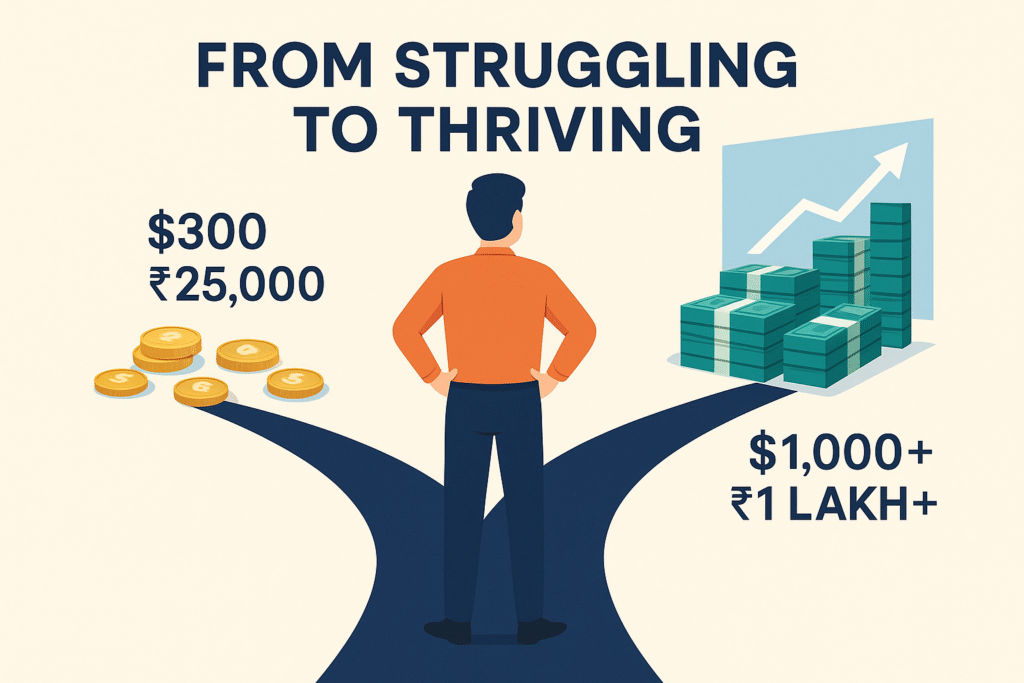
    More than 90% of people in India earn less than ₹25,000 per month (around $300).

    Only 3–5% earn above ₹1 lakh (about $1,200).

    But this is not just India. Globally too, most people are stuck under $300–$500 a month, and only a few cross $1,000+.

    Still, you too can go from ₹1 lakh or $1,000 to multiple lakhs or thousands every month.

    I have personally followed a process and generated this kind of income.

    Stay with me till the end of this post, and I’ll share that process in detail.

    (Video version here 👉 Watch on YouTube)

    Two Simple Paths to Create More Income

    When I talk about process, I mean two things:

    1. What you can do alongside your existing job.
    2. What you can add on as a new stream.

    Want to know your best starting point? Take my free quiz here:
    link.drashishjuneja.com/quiz

    Method 1: Offer Services

    The first method is to start offering services.

    Even in your job right now, you are already providing a service.

    You might think: “Won’t this become a second job?”

    Yes, maybe. But don’t worry about that right now. Once you find the right process and start earning more than your main job, you can quit the first one.

    My Example: LinkedIn Branding Services

    A few months ago, I offered LinkedIn branding services.

    I created content for people, helped with personal branding, and generated leads.

    For this, I charged ₹40,000 per client (around $500). I usually worked with 4–5 clients at a time.

    That came to about ₹1.6 lakh ($2,000) in a month.

    Later, I stopped because my passion since 2017 has always been coaching.

    Curious what services fit your skills? Take my quiz here:
    link.drashishjuneja.com/quiz

    What Services Can You Offer?

    Think about your domain. There is always extra work possible:

    • HR → Start HR consulting.
    • Sales → Offer sales consulting or training.
    • Marketing → Provide marketing consulting or training.
    • Academics → Thesis support, content writing, visiting lectures.

    When I was in academics, I often got thesis-writing work, content writing projects, and visiting lecture opportunities.

    Look into your own domain and see what extra you can do.

    Method 2: Learn High-Paying Skills

    We live in the internet age.

    Just search on ChatGPT or anywhere: “most sellable skills right now” or “future high-paying skills.”

    Some of the top high-paying skills today are:

    • Copywriting
    • Affiliate Marketing
    • Digital Marketing

    These are powerful because you can either use them for yourself or offer them as services to others.

    Method 3: Teaching, Training, Coaching, Consulting

    This is my favorite.

    Here you can productize your expertise and share it with others.

    There are three models:

    1. Low-Ticket Courses

    If you have expertise in sales, HR, pharma, or marketing, make a short course.

    • Keep the price under ₹10,000 (around $120).
    • Even ₹3,000–₹4,000 (about $35–$50) works very well in India.
    • Record your domain knowledge.
    • Add value with industry examples.

    Even 10 sales of a ₹10,000 course (about $120) = ₹1 lakh (around $1,200).

    Even 10 sales of a ₹3,000 course (about $35) = ₹30,000 (around $360).

    Don’t overthink. If you lack ideas, ask ChatGPT. Alternatively, you can book a one-to-one call with me. I’ll help you find the right course idea.

    2. Mid-Ticket Courses

    Anything under ₹90,000 (around $1,000) is mid-ticket.

    If you believe people will buy your course at ₹50,000–₹90,000, go for it.

    But if you’re just starting, stick with low-ticket courses first. Build confidence and grow your base.

    3. E-books and Small Products

    Another option is writing an e-book.

    I know people selling $10–$20 e-books on Gumroad.

    Start by publishing content on Medium or Substack. Build visibility, then offer your e-book.

    At the end of your articles, simply say: “This entire process is explained in my book.”

    People will buy.

    My Example: NISM Videos

    On my YouTube channel, I uploaded videos for the NISM (mutual fund distributor exam). Out of 12 chapters, I uploaded 8–9 as free videos.

    Below those videos, I added a link to a ₹199 (about $2.50) one-pager product. I didn’t even mention it in the video — just quietly placed the link.

    Students watched the free videos, clicked the link, and bought the product automatically.

    Till now, without active selling, that ₹199 (about $2.50) product has brought me ₹9,000–₹10,000 (around $110–$120).

    That’s exactly how you too can start small and grow.

    Final Thoughts

    You don’t need to make a big leap at once.

    Start with services, pick a high-paying skill, or create a small product like a course or e-book.

    Even ₹30,000 (about $360) extra income can change your confidence.

    Once you master the process, earning a ₹25,000 (around $300) salary is just the beginning.

    Increasing your income to ₹1 lakh+ per month (about $1,200+) becomes realistic.

    If you’re serious about making this jump, start by taking the quiz here:link.drashishjuneja.com/quiz

    Monetize your expertise. That’s the key.