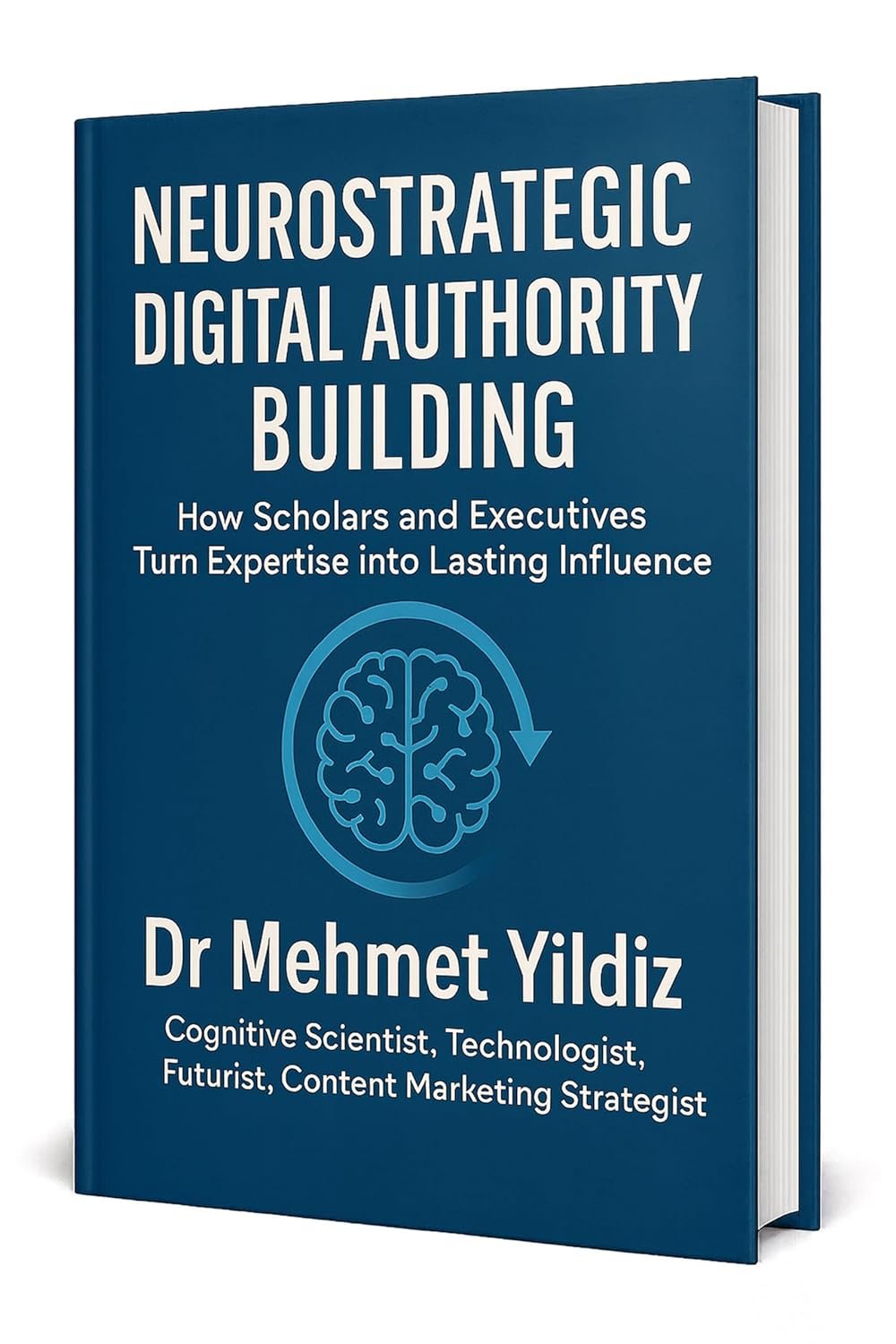
I preordered the Kindle edition of Neurostrategic Digital Authority Building: How Scholars and Business Executives Turn Expertise into Lasting Influence.
The book’s overall idea excited me because it resonated with both scholars and executives. Also, the title “Digital Authority Building” couldn’t keep me away. Most books on “personal branding” or “thought leadership” deserve a single skim, but this is to be read and reread.
It is not a book about branding. It is a 460-page, 43-chapter argument about how the human brain decides whom to trust, and what that means for anyone whose career depends on being heard. As a coach working in Digital Economics, I’ve always wanted to hear what people on the other side decide neurostrategically.
I want to explain why this book matters, what it actually contains, who should read it, and where I personally pushed back. I will also share my key takeaways from the book.
The Most Misdiagnosed Problem: The Book Names
Executives and academics have spent years building expertise. Many have already run departments, published research papers, and mentored people, but online, they are invisible. For academicians, their research journal might be their arena, and for executives, the organization is their playing field.
Generally, you are advised to post more, be consistent, and build your personal brand. It is the same repetition you will hear from any creators, but people forget that key executives and academics cannot produce mass output or low-value work. Dr. Yildiz argues that this is a fundamental category error.
According to Dr. Mehmet Yildiz, authority is not granted by output. It is granted by the audience’s brain, and the audience’s brain is governed by attention, trust, and memory, three faculties that have measurable rules.
Many of us in the market do not understand these rules or what actually happens: more output creates more friction. This leads to investing time without creating influence.
Dr. Mehmet Yildiz has created a community of 8,00,000 readers. When a book comes from his authority, it cannot be overlooked.
I really admire him because he has played various roles: a former IBM employee, a university educator, and now a writer and community creator.
According to him, authority has undergone a structural shift. Previously, authority was in the titles you held and the credentials you carried. Now, in a digital environment where there is a continuous stream of voices, it is difficult to build your authority.
The brain looks for clarity, relevance, and coherence, and continuously filters and evaluates. This is the diagnosis that runs through the entire book, and it is also why I think most existing books on “thought leadership” might look obsolete the moment you finish this one.
What the Framework Actually Argues
In chapter 13 Dr Mehmet shares “Defining Neurostrategic Authority Building: A Cognitive-Science Framework.”
Here he introduces the framework formally, built on three cognitive layers I will paraphrase rather than quote.
1. Attention as the gateway.
2. The second is trust as the foundation
3. The third is memory as the durability mechanism
Human attention is finite. You can look around and will see that most signals never enter conscious awareness at all. Your audience is dismissing that before evaluation. Authority is not what you say, but ideally, it is something that survives the filter.
The second is trust as the foundation. Once the threshold of attention is achieved, the brain now shifts to a major question. Can this signal be relied upon?
Dr. Mehmet shares that trust is developed through repeated exposure. It is very easy to destroy trust with inconsistencies in voice, tone, intent, and behavior. This is the part of the book I underlined most heavily, because it is also where most online experts fail. They optimize for attention and accidentally destroy trust in the same motion.
The third is memory as the mechanism of durability. The brain retains very little of what it encounters. Research said we retain only 25 percent after 24 hours. Now, when attention span is too low, retention is minimal. So people will forget your posts and even what they commented on.
He treats memory consolidation as the missing leg of most authority strategies, and he is right.
In Chapter 37, he formalizes these layers into what he calls the Neurostrategic Authority Loop™. According to him, it is a sequence that runs from focused attention through interpretation, trust, memory, retrieval, and decision, ultimately generating reinforced attention on the next encounter.
This loop is the part of the book I will recommend revisiting again and again because it explains why authority compounds for some practitioners and stalls for others.
Some of us are putting in a lot of effort, but it is not effort that compounds. It is the cognitive cycle that compounds when each interaction reinforces the previous one.
What Makes This More Than Cognitive Psychology Repackaged
Sometimes there is a risk in reading a book that claims to apply neuroscience to communication. This becomes interesting now because Dr. Yildiz is someone who is a postdoctoral researcher in cognitive science and a former Distinguished Enterprise Architect, and he has reportedly ghostwritten more than 100 books for senior executives.
The framework reads like the consolidation of two careers, not the repackaging of a TED talk. Dr. Yildiz has also shared case studies in Chapter 31.
He has shared real authority-building patterns.
- The prolific scholar whose name was known inside academia but absent outside it.
- The CEO, who outsourced his content to an agency, began to doubt that he had any unique perspective at all.
- The finance executive who became obsessed with LinkedIn follower counts, while internal surveys showed neither employees nor clients regarded him as a thought leader.
Each case study extracts a specific failure mode of authority and ties it to a missing cognitive principle.
In Chapter 33, he shares “Beware of Hope-Based Funnels.” Dr. Yildiz introduces the term Hope-Based Funnels™ to describe a category of digital monetization that operates within accepted marketing norms. The hope-based funnels exploit the brain’s processing of hope, urgency, and aspiration under economic stress.
He draws on Daniel Kahneman’s distinction between fast and slow thinking to explain why these funnels convert. Dr. Yildiz notes that these funnels are designed to activate the intuitive system before the analytical system engages.
He hasn’t shared any names, but if you have spent time in the online creator economy, you will recognize the pattern within two paragraphs. He shares what happens when visibility strategies prioritize emotional acceleration over cognitive alignment.
In Chapter 38, “The Neurobiology of Authority,” he shares the neuroscience underlying the framework.
Where the Book Is Strongest
The book is strongest where it rejects the genre’s common shortcuts.
Three things stood out to me.
- It does not promise virality. Instead, it actively warns against pursuing viral content because, by the book’s cognitive logic, virality is almost the opposite of authority. Virality is attention without trust, and attention without trust leads to low authority. This is also true, as many creators went viral but lost their influence.
- Dr. Yildiz never said in the book, “authority can be built in thirty days, sixty days, or any of the timelines marketed by online programs.” The model is to compound signals across years. The book carries the same temperament. There is no fast hack or cheat sheet to reward you with fast authority and cash
- The book is published through his own imprint, S.T.E.P.S. Publishing Australia, and reflects the author’s stated work as chief editor of more than twenty Medium publications, founder of a writing community with over forty-two thousand contributors, and Substack operator with hundreds of thousands of subscribers. When he discusses the mechanics of credibility signals, he is describing infrastructure he has actually built over the years.
Where I Pushed Back
The book is calibrated for an audience that already has substance. If you are a junior professional still building expertise and have no visibility for your framework, it will feel premature.
Dr. Yildiz would agree with me. Authority cannot be neurostrategically built on top of an empty foundation, and the book assumes you have already done that work.
The prescriptions are demanding for time-pressed executives. Chapter 15, on building an Authority Calendar, advocates for content distribution across multiple owned and earned platforms with consistent intellectual signaling over the years.
I practically feel it is difficult for a CEO, dean, or department head with is already overloaded calendar. The book discusses solutions in Chapters 24-27, curated teams, multidisciplinary expertise, the role of a curator as a “linchpin,” and delegation without dilution.
Personally, I would suggest that a leader with only 90 minutes a week can apply the principles over six months, which should have been shared in the book.
As a coach who has implemented variations of this with my own clients, I can tell you that sequencing is where most attempts collapse. The framework is sound, and I believe the on-ramp could be sharper.
What Changed in Me
This is what I learned. After reading the book, I realized writing for an algorithm is a bad idea, but writing for memory is the key. For about a year, I measured my content’s performance on LinkedIn by impressions and engagement.
After this book, I asked a different question:
Will any reader still be able to recall the central idea of this post a week from now? Almost none of my old posts survived that test.
I realized one thing: whatever I publish, how can I get it into the ideal customer’s memory?
Once, I had already lost 480k views on my Quora account. Now I treat my website, drashishjuneja.com, as the center and the platforms as feeders, not the other way round. This is exactly the architecture the book advocates, and the architecture I am now teaching my own clients.
The Chapter 23 discussion of cognitive scaffolding made me re-read my own published posts as a stranger would. I had been using dashes and overly formatted structures that, at times, mimic the visual grammar of AI-generated content.
The book’s argument, supported by the neurobiology in Chapter 38, is that this kind of formatting actually increases cognitive load rather than reducing it. It signals noise, not clarity, to a discerning reader.
The Five Themes I Am Anchoring My Own Work Around
The clearest practical outcome of reading this book, for me personally, has been deciding what I am no longer going to write about and what I am going to commit to.
Chapter 17 argues that scattered messaging fails because the brain cannot encode patterns from noise. Your brain needs anchors.
After working through that chapter and the surrounding material on cognitive scaffolding, I sat down and asked myself a harder question than usual. If a reader could only remember me for a small set of ideas, which ideas would I want those to be?
The answer, after several drafts, came down to five:
- Digital Economics – the structural rules of how value is created, captured, and distributed in a post-industrial economy where distribution is free but attention is scarce.
- Demand Creation – how serious practitioners cultivate genuine demand for their work over time, as opposed to the hope-based persuasion patterns.
- Authority & Trust – the territory the book itself maps so carefully, and the territory I work within every day with clients.
- Value & Monetization – the practical translation of expertise into income, with the discipline to distinguish real value from the appearance of it.
- Conversion & Decision-Making — the cognitive layer of how people actually move from interest to action, and how to design for that movement honestly.
I am sharing this not as a content marketing announcement but as an act of public commitment. Dr. Yildiz says you should decide on 3-5 core themes and repeat them for years and years until they stick in your audience’s minds.
I even personally asked myself these questions.
1. What is Justin Welsh known for?
2. What is Dan Koe known for?
3. What is Dr. Mehemt Yildiz known for?
4. What is Siddharth Rajsekar known for?
5. What am I known for?
The book is correct in stating that themes function as cognitive anchors only when they are repeated across contexts and reinforced over time. I am putting these five on the record so that I am accountable to them, and so that readers know what to expect from me going forward.
I will say honestly that Dr. Yildiz himself, in Chapter 39 of this same book, warns about the limits of repetition without depth, and I have taken that warning seriously.
For me, the five themes is a commitment to a territory; the harder work, which I am still doing, is finding the one underlying argument that connects them. That work continues. This review is one step in it.
Who Should Read It And Who Should Not
If you are an academic, a senior executive, a senior consultant, or a serious independent practitioner who has accumulated genuine expertise and is frustrated that the digital world does not seem to know it, read it.
If you have tried generic personal-branding advice and found it shallow.
Read it if you suspect correctly that visibility and credibility are not the same problem.
The Hope-Based Funnels chapter alone is worth the book’s price for anyone considering enrollment in an expensive online program.
Do not read this book if you want a viral hook formula, a thirty-day plan, or a list of templates. It is not that kind of book. It will, in fact, gently insult that kind of expectation. It is a book for people who are willing to think slowly about something they intend to do for the rest of their working lives.
A Final, Honest Word
I should disclose two things plainly.
1. Dr. Yildiz is a mentor of mine, and I have been on the receiving end of his coaching for more than a year, which gives me access and bias. In this review, I’ve tried to be precise about what the book does well and where I struggled with it, because anything less would dishonor both the book and the relationship.
2. I am also a working practitioner who analyzes and fixes the hidden bottlenecks in how money flows through your business. Some of what Dr. Yildiz argues, I had partially understood from my own work.
If you have built genuine expertise and you want it to compound into lasting influence, this is the book to read this year. It is not a quick read. It is, deliberately, the opposite of a quick read. That is the point.
Where to buy the book: Neurostrategic Digital Authority Building: How Scholars and Business Executives Turn Expertise into Lasting Influence by Dr Mehmet Yildiz (First Edition, April 2026, S.T.E.P.S. Publishing Australia, 460 pages, 43 chapters) is available on Kindle and through universal book links at books2read.com/neurostrategy. I bought my copy on Kindle.
About Dr. Mehmet Yildiz: A post-doctoral researcher in cognitive science, distinguished enterprise architect, and author of more than forty books on technology, content strategy, and cognitive performance. His content ecosystem at digitalmehmet.com is itself a working illustration of the framework this book describes.
About the reviewer: Dr Ashish Juneja teaches professionals, coaches, and senior independent practitioners to build digital authority and monetize their expertise. The five themes anchoring his future work —Digital Economics, Demand Creation, Authority & Trust, Value & Monetization, and Conversion & Decision-Making—are explored in depth at drashishjuneja.com.
4 Responses
Dear Dr Ashish, thank you for writing this scholarly and educational review. Your understanding of the book is spot. I admire your work in this space and wish you the best in your journey.
I agree
I found this excellent review via Google today. Well done Dr Ashish! As I edited and read this book your review made sense to me.
Thank you, Dr Michael. Amazing to hear your views.