Category: Mindset

  • Why I Read Neurostrategic Digital Authority Building And What It Changed in My Own Practice
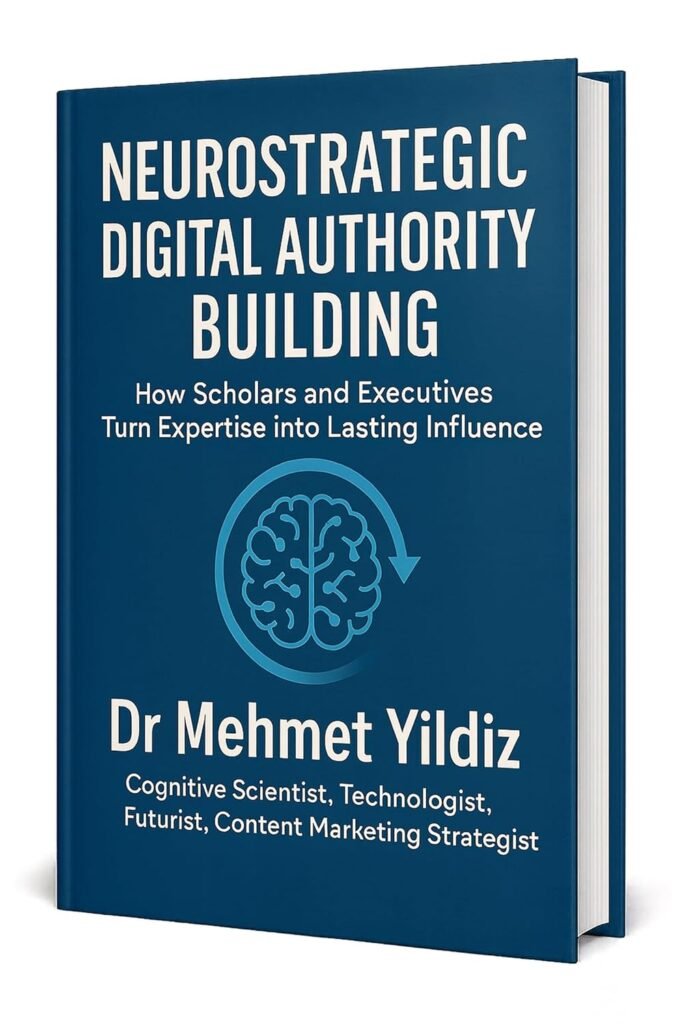
    I preordered the Kindle edition of Neurostrategic Digital Authority Building: How Scholars and Business Executives Turn Expertise into Lasting Influence.

    The book’s overall idea excited me because it resonated with both scholars and executives. Also, the title “Digital Authority Building” couldn’t keep me away. Most books on “personal branding” or “thought leadership” deserve a single skim, but this is to be read and reread.

    It is not a book about branding. It is a 460-page, 43-chapter argument about how the human brain decides whom to trust, and what that means for anyone whose career depends on being heard. As a coach working in Digital Economics, I’ve always wanted to hear what people on the other side decide neurostrategically.

    I want to explain why this book matters, what it actually contains, who should read it, and where I personally pushed back. I will also share my key takeaways from the book.

    The Most Misdiagnosed Problem: The Book Names

    Executives and academics have spent years building expertise. Many have already run departments, published research papers, and mentored people, but online, they are invisible. For academicians, their research journal might be their arena, and for executives, the organization is their playing field.

    Generally, you are advised to post more, be consistent, and build your personal brand. It is the same repetition you will hear from any creators, but people forget that key executives and academics cannot produce mass output or low-value work. Dr. Yildiz argues that this is a fundamental category error.

    According to Dr. Mehmet Yildiz, authority is not granted by output. It is granted by the audience’s brain, and the audience’s brain is governed by attention, trust, and memory, three faculties that have measurable rules.

    Many of us in the market do not understand these rules or what actually happens: more output creates more friction. This leads to investing time without creating influence.

    Dr. Mehmet Yildiz has created a community of 8,00,000 readers. When the book comes from his authority, the book cannot be overlooked.

    I really admire him because he has played various roles: a former IBM employee, a university educator, and now a writer and community creator.

    According to him, authority has taken a structural shift now. Previously, authority was in the titles you held and the credentials you carried. Now, in a digital environment where there is a continuous stream of voices, it is difficult to build your authority.

    The brain looks for clarity, relevance, and coherence, and continuously filters and evaluates. This is the diagnosis that runs through the entire book, and it is also why I think most existing books on “thought leadership” might look obsolete the moment you finish this one.

    What the Framework Actually Argues

    In chapter 13 Dr Mehmet shares “Defining Neurostrategic Authority Building: A Cognitive-Science Framework.”

    Here he introduces the framework formally, built on three cognitive layers I will paraphrase rather than quote.

    1. Attention as the gateway.

    2. The second is trust as the foundation

    3. The third is memory as the durability mechanism

    If you look at human attention, it is finite. You can look around and will see that most signals never enter conscious awareness at all. Your audience is dismissing that before evaluation. Authority is not what you say, but ideally, it is something that survives the filter.

    The second is trust as the foundation. Once the threshold of attention is achieved, the brain now shifts to a major question. Can this signal be relied upon?

    Dr. Mehmet shares that trust is developed through repeated exposure. It is very easy to destroy trust with inconsistencies in voice, tone, intent, and behavior. This is the part of the book I underlined most heavily, because it is also where most online experts fail. They optimize for attention and accidentally destroy trust in the same motion.

    The third is memory as the mechanism of durability. The brain retains very little of what it encounters. Research said we retain only 25 percent after 24 hours. Now, when the attention span is too low, the retention would be minimal. So people will forget your posts and even what they commented on.

    He treats memory consolidation as the missing leg of most authority strategies, and he is right.

    In Chapter 37, he formalizes these layers into what he calls the Neurostrategic Authority Loop™. According to him, it is a sequence that runs from focused attention through interpretation, trust, memory, retrieval, and decision, ultimately generating reinforced attention on the next encounter.

    This loop is the part of the book I will recommend to revisit again and again because it explains why authority compounds for some practitioners and stalls for others.

    Some of us are putting in a lot of effort, but it is not effort that compounds. It is the cognitive cycle that compounds when each interaction reinforces the previous one.

    What Makes This More Than Cognitive Psychology Repackaged

    Sometimes there is a risk in reading a book that claims to apply neuroscience to communication. This becomes interesting now because Dr. Yildiz is someone who is a post-doctoral researcher in cognitive science and a former Distinguished Enterprise Architect, and he has reportedly ghostwritten more than 100 books for senior executives.

    The framework reads like the consolidation of two careers, not the repackaging of a TED talk. Dr. Yildiz has also shared case studies in Chapter 31.

    He has shared real authority-building patterns.

    1. The prolific scholar whose name was known inside academia but absent outside it.
    2. The CEO, who outsourced his content to an agency, began to doubt that he had any unique perspective at all.
    3. The finance executive who became obsessed with LinkedIn follower counts, while internal surveys showed neither employees nor clients regarded him as a thought leader.

    Each case study extracts a specific failure mode of authority and ties it to a missing cognitive principle.

    In Chapter 33, he shares “Beware of Hope-Based Funnels.” Dr. Yildiz introduces the term Hope-Based Funnels to describe a category of digital monetization that operates within accepted marketing norms. The hope-based funnels exploit the brain’s processing of hope, urgency, and aspiration under economic stress.

    He draws on Daniel Kahneman’s distinction between fast and slow thinking to explain why these funnels convert. Dr. Yildiz notes that these funnels are designed to activate the intuitive system before the analytical system engages.

    He hasn’t shared any name, but if you have spent time in the online creator economy, you will recognize the pattern within two paragraphs. He shares what happens when visibility strategies prioritize emotional acceleration over cognitive alignment.

    In Chapter 38, “The Neurobiology of Authority,” he shares the neuroscience underlying the framework.

    Where the Book Is Strongest

    The book is strongest where it rejects the genre’s common shortcuts.

    Three things stood out to me.

    1. It does not promise virality. Instead, it actively warns against pursuing viral content because, by the book’s cognitive logic, virality is almost the opposite of authority. Virality is attention without trust, and attention without trust leads to low authority. This is also true, as many creators went viral but lost their influence.
    2. Dr. Yildiz, in the book, never said: “authority can be built in thirty days, sixty days, or any of the timelines marketed by online programs.” The model is to compound signals across years. The book carries the same temperament. There is no fast hack or cheat sheet to reward you with fast authority and cash
    3. The book is published through his own imprint, S.T.E.P.S. Publishing Australia, and reflects the author’s stated work as chief editor of more than twenty Medium publications, founder of a writing community with over forty-two thousand contributors, and Substack operator with hundreds of thousands of subscribers. When he discusses the mechanics of credibility signals, he is describing infrastructure he has actually built over the years.

    Where I Pushed Back

    The book is calibrated for an audience that already has substance. If you are a junior professional still building expertise and have no visibility for your framework, it will feel premature.

    Dr. Yildiz would agree with me. Authority cannot be neurostrategically built on top of an empty foundation, and the book assumes you have already done that work.

    The prescriptions are demanding for time-pressed executives. Chapter 15, on building an Authority Calendar, advocates for content distribution across multiple owned and earned platforms with consistent intellectual signaling over the years.

    I practically feel it is difficult for a CEO, dean, or department head with is already overloaded calendar. The book discusses solutions in Chapters 24-27, curated teams, multidisciplinary expertise, the role of a curator as a “linchpin,” and delegation without dilution.

    Personally, I would suggest that a leader with only 90 minutes a week can apply the principles over six months, which should have been shared in the book.

    As a coach who has implemented variations of this with my own clients, I can tell you that sequencing is where most attempts collapse. The framework is sound, and I believe the on-ramp could be sharper.

    What Changed in Me

    This is the part that comes from my learning. After reading the book, I realized writing for an algorithm is a bad idea, but writing for memory is the key. For about a year, I had been measuring my content’s performance on LinkedIn by impressions and engagement.

    After this book, I asked a different question:

    Will any reader still be able to recall the central idea of this post a week from now? Almost none of my old posts survived that test.

    I realized one thing – whatever I am publishing, how can I get into the memory of the ideal customer?

    Once, I had already lost 480k views on my Quora account. Now I treat my website, drashishjuneja.com, as the center and the platforms as feeders, not the other way round. This is, in fact, exactly the architecture the book advocates, and the architecture I am now teaching my own clients.

    The Chapter 23 discussion of cognitive scaffolding made me re-read my own published posts as a stranger would. I had been using dashes and overly formatted structures that, at times, mimic the visual grammar of AI-generated content.

    The book’s argument, supported by the neurobiology in Chapter 38, is that this kind of formatting actually increases cognitive load rather than reducing it. It signals noise, not clarity, to a discerning reader.

    The Five Themes I Am Anchoring My Own Work Around

    The clearest practical outcome of reading this book, for me personally, has been deciding what I am no longer going to write about and what I am going to commit to.

    Chapter 17 of the book argues that scattered messaging fails because the brain cannot encode patterns from noise. Your brain needs anchors.

    After working through that chapter and the surrounding material on cognitive scaffolding, I sat down and asked myself a harder question than usual. If a reader could only remember me for a small set of ideas, which ideas would I want those to be?

    The answer, after several drafts, came down to five:

    1. Digital Economics – the structural rules of how value is created, captured, and distributed in a post-industrial economy where distribution is free but attention is scarce.
    2. Demand Creation – how serious practitioners cultivate genuine demand for their work over time, as opposed to the hope-based persuasion patterns.
    3. Authority & Trust – the territory the book itself maps so carefully, and the territory I work within every day with clients.
    4. Value & Monetization – the practical translation of expertise into income, with the discipline to distinguish real value from the appearance of it.
    5. Conversion & Decision-Making — the cognitive layer of how people actually move from interest to action, and how to design for that movement honestly.

    I am sharing this not as a content marketing announcement but as an act of public commitment. Dr. Yildiz shares that 3-5 core themes should be decided and repeated for years and years until they become fixed in your audience’s minds.

    I even personally asked myself these questions.

    1. What is Justin Welsh known for?

    2. What is Dan Koe known for?

    3. What is Dr. Mehemt Yildiz known for?

    4. What is Siddharth Rajsekar known for?

    5. What am I known for?

    The book is correct in stating that themes function as cognitive anchors only when they are repeated across contexts and reinforced over time. I am putting these five on the record so that I am accountable to them, and so that readers know what to expect from me going forward.

    I will say honestly that Dr. Yildiz himself, in Chapter 39 of this same book, warns about the limits of repetition without depth, and I have taken that warning seriously.

    For me, the five themes is a commitment to a territory; the harder work, which I am still doing, is finding the one underlying argument that connects them. That work continues. This review is one step in it.

    Who Should Read It And Who Should Not

    If you are an academic, a senior executive, a senior consultant, or a serious independent practitioner who has accumulated genuine expertise and is frustrated that the digital world does not seem to know it, read it.

    If you have tried generic personal-branding advice and found it shallow.

    Read it if you suspect correctly that visibility and credibility are not the same problem.

    The Hope-Based Funnels chapter alone is worth the book’s price for anyone considering enrollment in an expensive online program.

    Do not read this book if you want a viral hook formula, a thirty-day plan, or a list of templates. It is not that kind of book. It will, in fact, gently insult that kind of expectation. It is a book for people who are willing to think slowly about something they intend to do for the rest of their working lives.

    A Final, Honest Word

    I should disclose two things plainly.

    1. Dr. Yildiz is a mentor of mine, and I have been on the receiving end of his coaching for more than a year, which gives me access and bias. I have tried, in this review, to be precise about what the book does well and where I struggled with it, because anything less would dishonor both the book and the relationship.

    2. I am also a working practitioner who analyzes and fixes the hidden bottlenecks in how money flows through your business. Some of what Dr. Yildiz argues, I had partially understood from my own work.

    If you have built genuine expertise and you want it to compound into lasting influence, this is the book to read this year. It is not a quick read. It is, deliberately, the opposite of a quick read. That is the point.

    Where to buy the book: Neurostrategic Digital Authority Building: How Scholars and Business Executives Turn Expertise into Lasting Influence by Dr Mehmet Yildiz (First Edition, April 2026, S.T.E.P.S. Publishing Australia, 460 pages, 43 chapters) is available on Kindle and through universal book links at books2read.com/neurostrategy. I bought my copy on Kindle.

    About Dr. Mehmet Yildiz: A post-doctoral researcher in cognitive science, distinguished enterprise architect, and author of more than forty books on technology, content strategy, and cognitive performance. His content ecosystem at digitalmehmet.com is itself a working illustration of the framework this book describes.

    About the reviewer: Dr Ashish Juneja teaches professionals, coaches, and senior independent practitioners to build digital authority and monetize their expertise. The five themes anchoring his future work —Digital Economics, Demand Creation, Authority & Trust, Value & Monetization, and Conversion & Decision-Making—are explored in depth at drashishjuneja.com.

  • Your Salary Is Not Security. Mine Wasn’t Either.

    Your Salary Is Not Security. Mine Wasn’t Either.

    It was 31st December 2023, and one phone call changed everything for me in less than two minutes.

    My subordinate called me – He said: “Sir, haath mein kuch hai kya?” – “Sir, do you have anything in your hand?”

    I said: “Haath mein matlab?” – “What do you mean, ‘in hand’?”

    He said: “Matlab job.” – “Meaning, a job.”

    I said: “No.”

    He said: “Bauji keh rahe the — Juneja ji se boliyega, kal se nahi aayenge.” – “Bauji was saying—tell Juneja-ji that he won’t be coming starting tomorrow.”

    That was it, no warning, no conversation, and no meeting, just a phone call from my own subordinate telling me I no longer had a job.

    I had a PhD in Economics and 17 years of experience teaching, building, and leading, but nothing could save me.

    In August 2023, I left academia when the new organization’s owner asked me to join the senior ranks. For four months, I had given whatever I could to the organization, from late-night visits at 3 AM to revisitations at 10 PM at times, but the job ended in less than two minutes.

    What happened next broke something inside me

    A few weeks later, India was celebrating the Pran Pratishtha of the Ram Mandir in Ayodhya on 22 January 2024.

    The entire country was watching it live on television. We were also at home, ready to worship LIVE. It was one of the most sacred moments in recent Indian history. I was standing on my terrace and still scrolling, searching, and refreshing Naukri.com.

    Honestly, I was like a beggar with a PhD — searching for someone to hire me.

    That image of myself standing alone on that terrace while the whole country celebrated is something I will never forget. I had spent 17 years becoming indispensable inside organizations, and in that moment, I realized something permanently. Inside the organization, you are indispensable, and outside it, you are zero.

    This was not my first job loss. I had a job loss before this, too, but this one was different and was a big blow to me. Each time, I told myself the same story: “I’ll find something better.”

    During the COVID pandemic, a similar story happened, and I was back working with a university in 2021, where I worked until August 2023.

    I always had the option to return to my previous academic employer, but I decided not to.

    This time it was different. I was standing on that terrace, and something spoke to me from inside: “Ye bhi baith gaye hain. Ab tu bhi baith ja.” “Lord Ram has sat down too. Now you sit down as well.”

    I decided to stop job hunting, but to continue with what I know, using my existing skills and knowledge in the service of others.

    Flashback to 2014, when my entrepreneurship journey started

    I had left a management institute where three months’ salary was pending; I was frustrated and felt undervalued. I did what any ambitious person does: I built something of my own. I took over a franchise of a coaching and training institute in Kashipur.

    A few weeks later, my employer asked me to choose one. He said, “We want you 100 percent. We love your work, but want you one hundred percent. Decide.”

    I decided on self-employment, and the Institute’s journey began with the first admission in April 2014, which grew to hundreds that year and eventually reached thousands. Students cracked bank exams, government jobs, built careers, and I ran it for six years.

    The master blaster COVID arrived in 2020. COVID didn’t negotiate with me, and it didn’t send a warning letter

    It didn’t care about my admissions numbers or my reputation, and in 90 days, everything was gone.

    Two closures, Two complete losses, Two times starting from zero.

    And yet, both times, I went back to depending on someone else’s system.

    I sold an asset worth ₹90,000 to invest in learning how to build digital freedom. That same asset would be worth ₹7,20,000 today. No regrets for that because that investment gave me something no organization could ever give me: a system I now teach others.

    In 2019, I made a decision that changed everything

    I learned from mentors, attended webinars, and earned my first affiliate commission. I finally understood that money doesn’t have to come only from trading time, but I still didn’t fully commit. I was still dependent and still waiting for a salary until that terrace moment in January 2024.

    31st Dec 2203 job loss hit me hard.

    After the Ram Mandir Pran Pratishtha, I made a decision. I requested God, “Please do something so that no one can fire me again.”

    I stopped refreshing Naukri, I stopped sending applications, I stopped waiting for someone to hire me.

    I started with what I already had — the ability to help professionals find their niche and monetize their expertise.

    I had done it for others inside the Wealth Accelerator Hub, and I have seen it work, and now I would do it for myself.

    I built what I now call the Digital Economics System. The MIMO process — Market Intelligence, Market Offer.

    The NOAR (Niche, Offer, Audience Revenue) and the CAR (Clarity, Authority, and Revenue) formula.

    I started taking calls and charging for my time. I started helping professionals who were exactly where I had been — skilled, experienced, but completely dependent on a single salary from a single company that could end it all with one phone call.

    Six months later, I spoke to a manufacturing professional named Sajal

    He went to the office every day, did his job, and lived his life, but he had a skill no one at his company knew about. We identified it, built an offer around it, and ran the MIMO process.

    Within weeks, Sajal earned ₹25,000 on the side while still going to the office every morning, not because he was extraordinary, but because he finally had a system.

    Here is what I want you to understand

    You are not unemployable outside your job; you are just unaware of your own value, which is the gap I fix.

    The professionals I work with are not failing because they lack skills; they are failing because they have never been shown how to position those skills outside their organization.

    Your job gives you income, but your expertise, if packaged correctly, can give you income for life.

    The question is not whether you are capable enough. The question is: Are you building something nobody can take from you?

    One phone call can end your job, but it cannot take away your knowledge, your system, your parallel income, and that is what Unfireable means.

    If you are an experienced Professional

    If you have 8+ years of experience and are skilled within your organization, but invisible outside it.

    If you have ever opened Naukri just to check, then this is your signal.

    The best time to build something outside your job is right now, while you still have it.

  • Salary is not stability – It is dependency

    Salary is not stability – It is dependency

    The hidden risk most experienced professionals never see coming — and what I did about it over 18 months.

    Recently, I had a discussion with someone who worked with companies generating ₹100-₹200 crore in annual revenue. He is sharp and experienced. When he speaks in a boardroom, people listen.

    This is his situation within the organization, but outside the employer’s walls, few people know him.

    Today, if he decides to leave or lose his job, his income will become zero, according to him.

    While listening to his story, I realized I had been in the same situation a few years ago. It took me years to understand the real meaning of stability. In reality, what I called stability was dependency.

    The illusion we are all living inside

    The moment your salary hits your bank account, you are happy and super convinced that you have a stable life and safety.

    You can pay bills and fund your goals. As long as everything is fine inside the organization, your role is secure, and the manager respects you. This is the best time when you will never think beyond it.

    When there are restructures and shifts in industry, something changes suddenly. Now your sole source of livelihood seems to be out of control.

    Many mid- to senior-career professionals have made them indispensable within one system. They are skilled and hardworking, and all their efforts and skills are deposited into an account they do not own.

    This leads to one big problem: inside your company, you are indispensable; outside your company, you are zero.

    This hidden risk is not dramatic. No one announces it, but it sits quietly under each career milestone.

    If your salary stopped tomorrow… what’s your backup?

    If you don’t have one, you don’t have stability.

    Join here and start building your first income system https://www.skool.com/digital-chai-club-8425/about

    What I did instead

    It is 28 months now without a full-time job, and it did not happen one fine day. What happened 28 months ago was more deliberate, and far less exciting — but it worked.

    From 2021 to 2023, while still employed full-time, I followed a simple sequence. Not a hack. Not a shortcut

    I just identified a skill that is paying me today as well.

    Identified one skill I was already being paid for

    Not a new skill. Not a trending one. The thing I already did well at work.

    Converted it into a clear, outcome-based offer

    Not “I do X.” But “I help you achieve Y in Z timeframe.”

    Spoke to real professionals before building an audience

    Validation before content. Demand before supply.

    Built a structured system — not random gigs

    A repeatable process, not a one-time project.

    Slowly, that became a second income. There was no viral moment. There was no overnight success story. There was only structure, applied consistently, over a long enough period to produce results.

    Systems work. Hoping does not.

    One thing I want to share with you. Your experience will not create freedom. Your experience is the raw material in the expertise economy. You need to package it well to be usable for others. Once packaged well and utilized in the service of others, it becomes a second income system.

    You have 15 years of experience, but no leverage.

    According to Naval Ravikant, there are three kinds of leverage

    1. Labour

    2. Capital

    3. Code

    4. Media

    When you leverage your skills, knowledge, and experience and package it well, it pays you. Now means you are building something that belongs to you, not to a company that could restructure at any moment.

    Many professionals want a second income, but they do not know where to start. They have no structure. The person I met is not lazy or unambitious, but he has never built a system. He kept trading time for salary and called it a career.

    There is nothing wrong with a salary. It is a useful tool, but when you are entirely dependent on it with no backup. That becomes a difficult situation.

    The path to the second position does not require you to quit your job. It does not require you to go viral or build a massive audience. It requires you to stop treating your salary as your only asset and start treating your skills as something you can package, position, and monetize on your own terms.

    The best time to build this is while you still have the salary to fall back on, the time to experiment, and the mental space to do it right. Not under pressure. Not after something has already gone wrong.

    That is the window. Most people miss it because it does not feel urgent until it is.

    Where are you right now?

    Salary or System?

    You Don’t Need Motivation. You Need a System.

    If this article made you question your salary… good.

    Now the next step is to build your first income system — without quitting your job.

    Inside my free community, I break this down step-by-step:

    • How to identify your monetizable skill
    • How to start your first income stream
    • How to escape single-income dependency

    A small, focused group of mid-to-senior professionals building career-safe parallel income from their expertise.

    Join the Free Digital Income Creators Community https://www.skool.com/digital-chai-club-8425/about

  • The Economic Trap of Single-Income Dependency

    The Economic Trap of Single-Income Dependency

    How Experienced Professionals Escape It Without Quitting Their Job)

    You’re not afraid of losing your job.

    You’re afraid of losing your salary.

    Your salary is deposited into your bank account on a specific date.

    Very much Predictable, reliable, and certain.

    You work for 30 days without thinking about it — and then it lands.

    With this predicatability it is normal to have

    Your EMIs. Your lifestyle. Your child’s school fees. Your peace of mind.

    Everything is tied to that one event – salary credit.

    Without realizing it, your entire psychological stability becomes dependent on a single source of income.

    This is not a motivation problem.

    This is an economic structure problem.

    Let’s break it down clearly.

    The Illusion of Salary Security

    Most experienced professionals believe they are secure because they are employed.

    But employment and security are not the same thing.

    Employment is a contract, and security is a structure.

    Your salary feels stable because:

    • It comes on time.
    • It requires no marketing.
    • It requires no selling.
    • It requires no uncertainty.

    You exchange time and expertise, and your organization absorbs market risk.

    The mutual arrangement gives you comfort.

    The deeper issue is that your lifestyle is built on a single-point dependency.

    If that one stream pauses, everything shakes.

    That is why the “what if?” loop begins.

    • What if restructuring happens?
    • What if performance ratings drop?
    • What if AI replaces the function?
    • What if the company pivots?

    Have you noticed something?

    You are not anxious during work hours.

    You are anxious on weekends because, when work stops, your mind replays its dependence.

    The salary feels certain, but the organization is not.

    Slowly, without you realizing it, security becomes an illusion.

    To protect your salary

    You overdeliver.

    You tolerate what you normally wouldn’t.

    You avoid risks you are capable of taking ot because you lack skill, but because dependency replaces control.

    The Psychological Cost of Single Income

    The real cost of single-income dependency is not financial.

    It is mental.

    When your livelihood depends on one source:

    • You hesitate to speak.
    • You avoid visibility outside the company.
    • You delay building something of your own.
    • You postpone long-term moves.

    And you convince yourself: “Let me stabilize first.”

    But stability never feels enough because the system itself is fragile.

    Here is the hard truth: Job security is not financial independence.

    It is job protection.

    Protection exists as long as the organization needs you.

    Independence exists when income does not depend on a single decision-maker.

    As an experienced professional, you are capable and skilled, with 8–15 years of experience.

    But you are economically fragile.

    You say: “I don’t lack confidence. I lack clarity.”

    Clarity about what?

    Clarity about how to convert experience into independent income.

    Until that clarity arrives, the dependency remains.

    And dependency quietly reduces your decision power.

    You cannot negotiate freely.

    You cannot experiment freely.

    You cannot think long-term.

    Your every move is measured against one question: “Will this affect my salary?”

    That is not freedom.

    That is structural dependence.

    The Shift: Monetize Expertise Before You Need To

    The solution is not quitting your job.

    The solution is restructuring your income.

    You do not remove dependency by emotional decisions.

    You reduce dependency by building parallel streams.

    The process is simple in theory — powerful in execution:

    1. Audit your expertise.
    2. Package it.
    3. Offer it.
    4. Build systems.
    5. Reduce psychological dependency before employment dependency.

    Let’s make this practical.

    Step 1 — Audit Your Economic Assets

    You have more assets than you realize.

    Your assets are not degrees.

    They are:

    • Industry experience
    • Process knowledge
    • Mistakes you’ve survived
    • Problems you’ve solved
    • Results you’ve created

    If you have worked for 8–10 years, you already have monetizable insight.

    The mistake professionals make is this: They see experience as “job history.”

    Instead, see it as “economic leverage.”

    Step 2 — Identify the Monetizable Core

    Not all skills are monetizable.

    But all experience contains monetizable components.

    Ask:

    • What recurring problems have I solved?
    • What results do I consistently create?
    • What transformation do people come to me for?

    You are not selling knowledge.

    You are selling outcomes.

    People do not pay for information.

    They pay for clarity and relief.

    Step 3 — Convert Skills into Structured Offers

    This is where most professionals fail.

    They say: “I can guide.” “I can mentor.” “I can consult.”

    That is vague.

    Structure converts expertise into income.

    An offer needs:

    • Clear audience
    • Clear problem
    • Clear outcome
    • Clear timeline
    • Clear process

    For example:

    Not: “I help with career clarity.”

    But: “I help mid-career professionals structure a second income system in 90 days without quitting their job.”

    Clarity creates conversion.

    Confusion creates content.

    Step 4 — Build Without Quitting

    This is critical.

    You do not need to resign.

    You need to execute in parallel.

    Even 5–8 focused hours per week can build:

    • Consulting
    • Coaching
    • Digital assets
    • Advisory services
    • Workshops
    • Paid communities

    Your job funds your transition.

    Your expertise builds your independence.

    This reduces risk instead of increasing it.

    Step 5 — Reduce Psychological Dependency First

    Here is something most people don’t talk about.

    The first independence is mental.

    When you earn even 20–30% of your salary from outside sources, something shifts.

    You speak differently. You negotiate differently. You think long-term. You feel less trapped.

    Not because you left.

    But because you have options.

    Options create confidence.

    Confidence reduces fear.

    Fear is what keeps most professionals stuck.

    My December 2023 Decision

    Until December 31, 2023, I was also dependent.

    I had built knowledge. I had built experience. But my income still came from one organization.

    When I lost my role, I had 22 days to decide.

    Return to job hunting.

    Or monetize what I already knew.

    It was not easy.

    I subscribed to job portals. I updated my resume. I explored opportunities.

    But then I paused.

    I asked a different question:

    “What if the real risk is staying dependent again?”

    The one thing I had done correctly before losing my role was this:

    I had built a system quietly.

    I had structured my expertise into a model. I had tested it. I had validated it.

    So instead of starting from zero, I started from where I already was.

    That shift changed everything.

    The income did not explode overnight.

    But the dependency has reduced.

    And with reduced dependency came clarity.

    Clarity before confidence.

    Confidence after execution.

    For the last two years, I have helped experienced professionals do the same.

    Not quit.

    Structure.

    Not panic.

    Prepare.

    Not dependent.

    Diversify.

    The Economic Decision You Must Make

    Monetizing your expertise is not a trend.

    It is an economic decision.

    The job market is evolving.

    AI is changing workflows.

    Organizations restructure faster than ever.

    You cannot control macro changes.

    But you can control income architecture.

    Ask yourself honestly:

    • If my salary is paused for 3 months, what happens?
    • Do I have an income system outside my employer?
    • Is my expertise packaged — or just used internally?

    You do not need to build an empire.

    You need to reduce fragility.

    Even one structured second stream changes your psychological posture.

    Security is not about salary size.

    It is about the income structure.

    What You Should Do Now

    Do not wait for pressure.

    Build before urgency forces you.

    Start here:

    1. Write down the top 5 results you have created in your career.
    1. Identify who would pay to achieve similar results.
    1. Define one clear transformation you can deliver in 60–90 days.
    1. Design a structured offer around it.
    1. Commit to weekly execution.

    No hype. No quitting. No dramatic moves.

    Just economic restructuring.

    The biggest career risk today is not losing your job.

    It is remaining dependent on a single income source for too long.

    You are not afraid of losing your job.

    You are afraid of losing your salary.

    That fear will remain until you build something beyond it.

    The question is not:

    “What if something happens?”

    The question is:

    “What am I building before something happens?”

    Start before you are forced to.

    Clarity comes from execution.

    And execution begins when you decide that economic independence is not optional — it is necessary.

  • Learning Is the New Procrastination: Why Skills Aren’t Increasing Your Income

    Learning Is the New Procrastination: Why Skills Aren’t Increasing Your Income

    You are neither lazy nor distracted.

    You have been learning, upgrading, and improving.

    Whatever certificates you pick, your income is not earned in proportion to the learning and effort.

    For you, learning has become a new procrastination.

    You were taught early in your career:

    1. Take more courses.

    2. Earn certifications

    2. Add more credibility to the profile

    Doing all the above helped you to climb the corporate ladder initially.

    New skills earned you a promotion and certification, resulting in salary increases.

    As a result, your confidence grew, but something stopped working.

    What was working for you is no longer working, and your growth is slow.

    Now you have hit the ceiling.

    It is not because you stopped working; rather, the existing organisational structure limits your growth.

    The only suitable option left with you is:

    “Let’s look for another job. My certificates will help me land the next job.”

    Certificates might help to some extent.

    The biggest question you need to ask is “Will the next job remove the ceiling — or just raise it slightly?

    When Your Skills Are Valuable at Work — But Worthless in the Market

    If you reflect, you will find that your skills are valuable only within your job.

    You are valuable because you have developed a specific skill.

    The demand for your work is dependent on the demand for that skill.

    The moment you step outside the organisation, you hit a surprise:

    The market does not value your skill the same way your employer does.

    There is a mismatch.

    Skill ≠ Demand

    Demand ≠ Skill

    With certain years of experience, you thought,t let me try:

    1. Freelancing

    2. Teaching

    3. Consulting

    None of this works the way it is working in your company.

    A college inviting you for a guest lecture is rarely pays you much.

    During the guest lecture, you are respected and honoured, but you receive only a few thousand rupees.

    Now you realise respect ≠ Income.

    The immediate solution that comes to your mind is:

    “To charge more money, I have to become better.”

    “Let me go back to preparation mode.”

    You are back in preparation mode.

    “Maybe I need one more certification. Maybe I should learn another framework. Maybe I’m not ready yet.”

    And without realizing it, you step into a loop that can last years.

    You overload yourself with:

    • Books
    • Certifications
    • Frameworks
    • Courses

    All in the name of becoming “valuable,” you enter a new loop.

    Accept this: “Knowledge, by itself, does not convert into money.”

    The market does not reward the most knowledgeable person, but rewards the most relevant person.

    The Silent Trap Keeping High Performers Stuck

    Countless high-performing professionals fall into a silent trap.

    You are serious about your work and capable, but you are stuck in perpetual preparation.

    If you are repeating this, stop immediately:

    1. Preparing instead of positioning:

    Your readiness will not come from knowing more but from being visible for something specific.

    2. Collecting skills instead of choosing a direction.

    More certifications and new capabilities feel like progress, but scattered skills dilute market demand.

    3. Staying “almost ready” for years.

    Always permanently on the edge of starting.

    What you are doing is psychological safety because, as long as you are preparing, you never have to face the risk of being judged by the market.

    Preparation is protecting your ego and not allowing you to fail.

    Positioning tests it, and most people unconsciously choose protection over progress.

    Clarity — The Real Breakthrough Behind Income Growth

    The moment you are aware of this, the change begins.

    You do not need more knowledge; you need monetization.

    The professionals who break income ceilings are not always the smartest, but they are the clearest.

    They make one powerful decision: They pick a niche.

    They decide who to help and build expertise in solving a single category of problems.

    You do not need to solve ten problems.

    Just solve one person’s problem, but ensure that it is a mass problem and the solution is scalable.

    Income = being specifically useful.

    When the market understands: “This is the person for this problem,”

    Your economic value changes not gradually but dramatically.

    Stop Preparing. Start Getting Paid.

    Before you enroll in the next certification, pause.

    Ask yourself a harder question than “What should I learn next?”

    Ask: “What do I already know that someone would pay to solve?”

    You need only one strategic move now:

    Choose one niche. Decide on the problem you want to solve. Help real people.

    Do not wait for perfect readiness.

    The market is not paying you to get ready.

    The market does not reward perfection.

    It rewards action combined with relevance.

    Experts are not built by learning endlessly. They are built bysolving problems repeatedly.

    Your Next Level Requires Courage — Not Another Certification

    What do you already know a lot about …. but still haven’t decided how to use?

    If you are unsure which path to choose to build a second Income in the next 90 days, join my upcoming workshop.

    Your next level is not hidden in another certification.

    It is hidden in the courage to step from preparation into monetization.

  • The Job You Can’t Afford to Lose Is Already Controlling You

    The Job You Can’t Afford to Lose Is Already Controlling You

    You Are Hired for One Role — But Paid to Survive Two.

    You are hired for two jobs but paid for one.

    This will sound strange, but you are doing two jobs.

    The first job is the role you are officially hired for.

    The second job is protecting the first one.

    Demanding jobs and work require you to under-commit and over-deliver.

    Working inside the organisation is constantly pushing you towards:

    1. High work pressure.

    2. Never-ending office politics.

    3. Continuous demand to upgrade skills.

    4. External market shifts

    At times, you are clueless about where to move.

    Should you work for survival or should you work for growth?

    The never-ending tasks, duties, and responsibilities is creating a hanging sword on your head.

    The Day Your Salary Starts Controlling You, Pressure Becomes Permanent.

    The result of never-ending expectations from your boss, organization, colleagues, and customers is pressure.

    To manage pressure on your head, you are:

    1. Staying late inside the organisation.

    2. Working for continuous visibility.

    3. Trying to stay relevant.

    4. Continuous actions towards being valuable.

    This is leading to the never-ending fear.

    You face fear not because you are incapable, but because you cannot afford to lose your current job.

    Due to pressure and fear, you are emotionally and physically affected.

    At times, the pressure becomes so big that you are in constant lookout for new opportunities outside your employment.

    You look for freelance projects, advisory roles, and independent work.

    In reality, you are seeking money always – you are seeking control.

    The power to control your circumstances.

    Somewhere deep inside, after 10–15 years in a job, a thought keeps returning:

    “What if I lose this job? How can I build something of my own?”

    The challenge is not desire.

    The challenge is not knowing how.

    Most experienced professionals misunderstand the maths and the path.

    Never ever leave the organisation because of your emotions or pressure.

    Leave the organization with planning and strategy, and not emotions.

    The real strategy is to continue with the organization while simultaneously building skills that are transferable beyond your job.

    Learn the Skills that you can:

    – Monetize – Package – Sell independently

    Start getting paid for what you already know.

    When your organisation can pay you, your experience already has market value.

    The process is also to identify and become valuable outside the organisation.

    Your knowledge already helps solve problems within the organisation.

    Your expertise is already earned.

    It simply needs a structure outside your designation.

    The most important truth is to stop copying someone else’s path to success.

    The Careers are personal.

    Your expertise is contextual.

    What worked for them is not automatically transferable to you.

    Build Skills That Pay Beyond Your Salary — And You’ll Never Fear a Paycheck Again.

    You can create income beyond your paycheck.

    What if you start earning without depending on a single paycheck?

    When you know that your skills have value beyond one organization, life becomes easy.

    You walk into work with confidence — not quiet dependency.

    You no longer search for stability but value.

    It is about building independence while staying stable.

    When your skills become portable, your career becomes resilient.

    You Don’t Need a Career Change — You Need a Monetization Strategy.

    As an experienced professional, you already know your skills have value inside the organisation, and you want to monetize your expertise.

    If you want to identify which of your skills can be shaped into independent income streams.

    You don’t need a dramatic career move.

    You need a deliberate strategy.

    Just come to an agreement on what you are good at?

    What do you love doing?

    What is the problem you can solve uniquely?

    For what can you be paid?

    Your Expertise Can Pay You More Than Your Job — If You Know How to Direct It.

    If you want to explore how to monetize your expertise beyond a job, book your Income Direction Call.

    Together, we will work on the direction and your expertise.

  • The Hidden Cost of Job Dependency Most Professionals Ignore

    The Hidden Cost of Job Dependency Most Professionals Ignore

    Why prolonged confusion quietly destroys professional careers

    Confusion is not a lack of clarity.

    Confusion is prolonged ambiguity — and it is fatal over time.

    You go to the office and come back home.

    Monday to Friday, you are required to be in the office. 

    The office that was giving you a cushion now feels restrictive.

    Freedom is not more freedom.

    You are looking for escape, but there is no escape.

    You believe you are seeking freedom.

    In reality, you are looking for relief.

    Every day, you promise yourself that you will go home and take action on your situation.

    You arrive home by 7 PM or 8 PM, and your family needs your attention.

    By the time it is 10 PM, you have planned your next day.

    A thought survives: One day, this will change.

    Why Changing Jobs Never Solves the Real Problem

    Whatever is happening today has been happening for months and years.

    The only 11th-hour solution is to change the job.

    You change the job/system, but the issue persists.

    Initially, for a few months, a new workplace and an enhanced salary work, but then it fails to motivate you.

    The real issue is not time but being dependent on the system.

    You are dependent on the system because:

    It is paying you money.

    It is building your authority

    It validates you through the hierarchy.

    Suddenly, the biggest fear arises:

    What if this system were to fade away one day?

    What if I am out ot the system?

    Will I look for another system?

    How long will it continue?

    The moment you have these fears, the mind becomes silent, and you have no answers.

    The only answer you have is to look for something.

    When you look for something

    First, you do not know what to look for.

    Second, when you look for something, you find the old advice on YouTube: hustle hard and do it at an early age. YouTubers are guiding you.

    Nothing matches with you because you have lived a few years in the system, and you believe no one understands your pain.

    You cannot adopt the advice of that YouTuber because

    1. You cannot risk your job

    2. You do not know how long it will take

    3. You cannot bear the pressure of public failure.

    4. You have bills to pay

    You are in continuous lookout for someone who has lived your experience and knows your pain.

    The Solution Isn’t Escape. It’s Economic Independence.

    Let me tell you straight, the solution is not escape.

    The solution is not hustle hard YouTuber advice.

    The solution is economic independence.

    The solution for you is to monetize your expertise.

    Create a system of your own.

    Build something that works beyond your daily presence.

    You have been working in your corporate job with your skills

    The solution now is to look beyond your corporate job.

    Answer these four questions for yourself

    1. What am I really good at?

    2. What do I love doing?

    3. What is the problem that I can solve uniquely in market place?

    4. For what can be paid for?

    If you answer all questions quietly, you will have a common theme.

    That common theme is the answer to your problem.

    What Changes When You Own Your Expertise

    When you own your expertise:

    • Your income is no longer borrowed
    • Your authority is no longer rented
    • Your confidence stops depending on one system

    Now, when uncertainitity occours, you stop panicking because you have found your game.

    You do not quit your job emotionally.

    You build the leverage strategically.

    You wait for the right time and let things compound.

    This is not a career change.

    This is career insurance.

    Why I Diagnose This Before Offering Any Solution

    This is exactly what I diagnose daily in working professionals who feel capable and experienced yet stuck.

    That’s why I run a paid Digital Economics Clarity Call.

    Not to motivate you or sell you dreams.

    But to help you:

    • See your expertise clearly
    • Identify your economic leverage

    Decide your next move before circumstances decide for you.

    Staying in Confusion Has a Cost

    You have been moving your days to months and months to years.

    Yet you are facing the same problem.

    It is said: if you are not growing, you are dying.

    With you, your problems should evolve.

    Confusion is not dangerous.

    Staying in confusion is.

    Prolonged ambiguity quietly kills careers.

    Decide consciously and decide structurally.

  • Fired On New Year Eve? My 4-Job Loss Escape Plan

    Fired On New Year Eve? My 4-Job Loss Escape Plan

    It was 31st December 2023.

    It was Sunday afternoon, and I was out of the station. The phone rang, and the call was from the office.

    I got a message from my Junior, “Sir Bauji is saying ask Juneja ji not to come from tomorrow.”

    The assignment that started 3 months ago ended on New Year’s Eve.

    Just a few seconds later, I was blessed at 1 PM.

    Unable to sustain the emotions, I asked myself what I could do now.

    In the next hour, luckily, I got a call from someone who became the assignment for the next 2 years.

    When I speak to many working professionals, I have realised many are stuck not because of skills but because of income.

    One decision maker can put a full stop to your income.

    I have already written about this in a LinkedIn post that got engagement because professionals feel this truth daily.

    I learned it painfully—after losing 4 jobs.

    If you are struggling post-job loss or you have a fear of job loss or job insecurity,here’s exactly what I built to escape.

    You can do this without quitting your job if your job is safe.

    Each time, I gave extra. Each time, one decision-maker ended it. Pattern clear: Your salary isn’t security. It’s a dependency.

    Survival Mode: The Coaching Franchise Years

    In 2014, I took the franchise of a coaching and training business, and till 2017, it was in survival mode.

    Some months, I was able to pay employees only, but could not create value for myself.

    Every night: “Will I always be at outside factors’ mercy?” Self-doubt is louder than fear.

    Extra effort bought time, not freedom. Needed different math.

    The Delhi Bus Ride

    In 2017, I got to know that people are creating something else and reaping rewards for years.

    I went on to attend a blogging event in Delhi.

    I saw creators doing the impossible: Content once paid repeatedly.

    No time trade. No boss. No layoffs.

    Digitally, I met one of mymentors, Siddharth Rajsekar. Attended Monday webinars and watched live sales.

    Something in me clicked, and I enrolled in courses and took action, and a few days later, got my first affiliate commission.

    Moment of truth: “You don’t need more effort to grow. You need models that grow when you stop.”

    My 3-System Escape Playbook (Proven)

    Over the years i have realised that mastering Digital Economics – turning knowledge into background income is the key.

    To play the game online, master this formula called VCP.

    1. Visibility

    2. Credibility

    3. Profitability

    System 1: Visibility (Content Attention)

    Now I am writing Daily on LinkedIn.

    When I started, I used to get 80 impressions and now: 400-800 impressions.

    The game is not impressions here; it is visibility.

    To give you some raw data. You can always expect 1-2% people clicking on the link that you share in the content.

    Assuming no one will click automatically.

    So your visibility can fuel your engine.

    Opportunities chase visible experts.

    Proof: Aman Gupta (boAt CEO). There are reports that 100% YoY sales jump.​

    Read: Beat Overanalysis – My Sunday SEO paralysis lesson.

    System 2: Authority (Knowledge Trust)

    When you start sharing your content, you build credibility and authority.

    If you are starting and want to create authority and credibility in your Niche/topic of expertise, do your 5P Niche Test:

    1. Passion – Are you passionate about the topic?
    2. Purpose – Do you have a purpose behind the topic?
    3. Problem – Are you solving a problem?
    4. Pain – Do people have urgent pain for the problem you are solving?
    5. Payment – Are people ready to pay for your topic?

    System 3: Income (Products Scale)

    I follow a system where my visibility feeds the credibility, and that feeds the profitability engine.

    The whole system I follow is

    1. Visibility Content Engine

    2. Leads – Discovery Calls

    3. Conversion engine – Revenue

    My content is feeding my micro sites that generate money through affiliate marketing.

    My traffic engine comes from content that moves people from content to leads.

    The last leads to conversions that fuel my revenue engine.

    Conclusion

    The jobs can end, and assignments can stop.

    Decision-makers change, but Systems have to compound.

    I realised the shift—from dependency to design—changed everything for me.

    And once you see it, you can’t unsee it.

    If this resonated with you, it probably means you’re thinking long-term about your career and income.

    You don’t need motivation — you need clarity.

    You have two simple next steps:

    Choose the path that feels right for you.

    Book a Clarity Call

    Join the Skool Community

  • Lost My Job — Here’s What Changed My Life Forever

    Lost My Job — Here’s What Changed My Life Forever

    Imagine waking up to find your work, your schedule, and your sense of direction — gone overnight.

    That’s what happened to me.

    I’ll tell you what I did through every phase — and what you can do when life suddenly changes course. Recently, a 21-month project came to an end. And once again, I’m preparing to rebuild — stronger and clearer than before.

    2014: The First Job Loss

    The first time I lost my job was in 2014. It was a completely different phase of life.

    I was working with a management institute, and almost three months of salary were pending. With every passing day, I kept wondering what could be done.

    A few months before the job actually ended, I got a chance to travel to Patna for institute work. The assignment involved meeting consultants who helped bring in students. Our task was to connect with them, discuss admissions, and they would then send students to our institute. That was how the system worked.

    When I met one of the consultants in Patna, I told my institute owner right there, “Sir, I don’t see much value here.” It didn’t materialize either. But during that process — because this was 2014, a restless phase of my life — I was ready to do anything.

    Three months of salary were due, and by 3:30 each day, the campus would be empty. Students would leave, and there would be long hours of free time. From 3:30 to 5:00 p.m., my mind kept spinning: How can I make money? When will the salary come? What can I do next?

    I used to think so much about my employer that I started analyzing his every move, trying to guess what he was thinking or planning. Looking back now, I realize how much mental energy I was wasting in overthinking.

    At one point, I even said to my colleague, “Let’s do one thing.” When you’re stuck in that kind of uncertainty, you start thinking creatively. I told him, “Let’s trade shoes. I’ll bring some from Roorkee — we can sell them here.” I loved the idea, but like many such ideas, it never materialized.

    Still, something valuable came out of that Patna trip. After giving a presentation at another institute, I casually asked the owner, “What do you teach?” He replied, “I don’t teach — I get it taught.” That line struck me like lightning. It was a complete bulb-on moment.

    Later, when we met a second consultant, he asked me, “Will you teach or will you do marketing?” Those two moments stayed with me. On the train back, I created a company called Topaz Consulting.

    A colleague who was with me helped draft the idea in a simple Google Doc. We even printed a few visiting cards — and that was it. Nothing much happened beyond that. But the seed had been planted.

    Franchising, a Tough Call — and Losing the Job

    After that, I spoke to a friend in Ludhiana who was running a coaching and training institute. I asked if we could do counseling for him through Topaz Consulting — the small company we had just formed. Maybe we could do similar work for him.

    It didn’t work out, but he mentioned that he had spoken to his owner and said, “What if we sell two franchises of this?” He asked me, “How would it be if we sold two franchise units?” I replied, “It’s tough, but let me try.”

    So we started trying because, frankly, nothing else was working. I was also looking for a job, but that too wasn’t happening. Days passed. Nothing seemed to move.

    Then one day I thought, What if I take this franchise myself? I started calculating the cost. I had some funds — part of it invested in stocks — available to me. I told myself, Why not take this up? So, I did.

    After taking the franchise, my job was still on. I hadn’t left. But as soon as I began setting things up — a small coaching and training center, a franchise of a well-known company from Jalandhar (focused on banking and training) — things started to change.

    Within a week, my employer called me. What he said felt straight out of the movie Guru.
    He told me, “Ashish, you’re a very good employee for us.” On the other side was my colleague, now my business partner. My employer continued, “You are very good. We want you fully with us. If you are with us, come fully. We don’t want halves.”

    That was the line — We don’t want halves.

    Perhaps I had watched Guru around that time; I even had a tie on. I remember thinking I should take it off. It wasn’t as easy as I say now — this was 2014, a very different time.

    At that moment, I looked at my colleague and then at my employer — a true entrepreneur-type person. He said, “Ashish, we want you completely. Either go your way — because I know you’ve invested heavily — or come 100% with us.”

    I paused for a moment, then physically took off my tie and said, “Sir, okay then, we’ll go there now.”
    That day, I lost my job. That was the first time.

    You might think it wasn’t exactly a job loss — that I was ready for it. But the truth is, we weren’t ready. I wasn’t ready. It was meant to be something part-time, something to run after college hours — maybe reduce institute time after 3:30 and work on it.

    It all happened because things weren’t going well. Had they been going well, I might never have taken that leap.

    After that, there was no turning back. I focused completely on what I had started. From 2014 till 2020, I gave it everything — full focus, full commitment. Then COVID came, and I had to close it down.

    After 2020: The Second Job Loss (Work-From-Home HR)

    After 2020, I moved to Gujarat. Since I had completed my PGDBM and other qualifications, I got an opportunity to work not with a university this time, but with a premium service-based organization — the largest mobile retailer in Gujarat.

    Things were going well until COVID hit. I had to return home, and work continued remotely.

    One day, while working from home, the salary was delayed. I was in HR, and everything had been smooth for the last four or five months. Normally, salaries were released between the 8th and 10th of every month. That time, it was delayed till the 12th.

    Some data sheets didn’t match, and just like that — I was fired. Simply fired.

    But that day, I gave a new meaning to the word “fired.”
    When someone says, “You are fired,” take it as “Your inner fire should rise.”

    Once again, I had nothing in hand. This was the real second job loss. The first one was by choice; this one wasn’t. Within just five months, it was all over.

    Still, I wasn’t the same person as before. I had completed my PhD, gained clarity, and knew that university openings were coming up. Three or four months later, I got an opportunity with a university again.

    I had lost the job in July — just after my birthday — and by October, I was back in work. Those four months in between weren’t wasted; I used them to work deeply on myself.

    31 December 2023: The Third Time (One-Man Show & No Settlement)

    The third time I lost my job, I was working in a factory-type setup — again in an HR role. Within just three months, on 31 December, I got a call from my junior. It was a typical one-man company — a complete one-man show. From experience, I’ve seen that in such setups, the day the owner decides your game is over, it’s over.

    That day, my junior — who had been with the company for 18 years and was close to the owner — called and asked, “Sir, is there anything in hand?” Then, almost hesitantly, he added, “Owner is saying that from tomorrow, do not come.”

    From 1 January to around 18 January, I tried everything. I applied on every job portal, reached out to every contact I could think of. Nothing worked. I even bought paid subscriptions on Monster and Naukri — spent a good amount through my credit card. Still, nothing clicked.

    Then came 18 January 2024. That moment changed everything. I told myself, “Enough. No more searching for a job.” Until that day, I had been desperately trying to find one. But from that moment onward, I stopped.

    From Job Hunt to Coaching Assignments (21 Months)

    A good thing happened on the 31st — as soon as the job ended, an opportunity appeared. Because I had already been involved in coaching and training assignments within the company — and in academics too — it felt natural to continue in that direction.

    Since 2017, I had been in and out of the coaching and training space, and that foundation helped me bounce back quickly.

    During this period, I worked deeply on myself — gaining niche clarity, refining curriculum design, and collaborating with people. I began focusing on one mission: monetizing expertise.

    This is what I now teach others — how to turn what you already know into something of value. I invested a lot of time in understanding it, testing it, and truly living it.

    Just two hours after my job officially ended on 31 December, I received a call: “Ashish, are you available? We have some assignments.”

    That assignment continued until 30th September 2025.

    So, in total, I’ve faced job loss four times.

    But this last one wasn’t exactly a job — it was a client engagement that brought consistent monthly value.

    For 21 months — almost like full-time work — it provided steady income.

    I was grateful for it. It gave me both stability and confidence while I continued building everything else around my purpose.

    If Your Job Is Gone: What Now?

    If such a job loss happens to you, what should you do?

    First, imagine the scene: this job loss has happened to you. It’s real. What next? You might be thinking, “Let’s do this.” Or “What are the options?”

    Let’s analyze the options you have now:

    • Thinking about the past: Why did it happen? Why me? Everyone else’s job is going on — why only me?
    • Wondering what you could have done better.
    • Talking to people for advice or sympathy.

    Most of the time, when we lose our job, our mind runs toward criticism. You want to prove yourself right.

    You replay everything: Why did it happen? Why me? What could I have done better? Maybe I’ll talk to them… maybe something will happen.

    But by doing this postmortem, you’re just dissecting the same body. Nothing changes. You’re the same. You’re not moving forward.

    There’s a beautiful Jay Shetty video titled “Why Suddenly Losing Your Job Is the Best Thing.” Watch it. It’s true.

    Every time I lost something, I realized the universe had already planted the next seed — even before I noticed.

    Acceptance First. Then Action.

    Your job is gone. Accept it as soon as possible. There’s no other way. Acceptance is the key.

    Then comes action. If you simply want another job, go for it. Apply on job sites, connect with people. Keep doing.

    But there’s another path — Mission 2035.

    Mission 2035: Community, Homeschooling, and Skills

    By 2035 it is predicted nearly 70% of today’s jobs will be gone. That’s a big number. But people won’t stop working — they’ll move toward self-employment.

    In 2035, self-employment will dominate; only about 30% will be in jobs.

    Community will be the new backbone. People will collaborate in smaller, skill-based groups.

    Homeschooling will grow, as parents realize jobs no longer come from traditional schooling alone. Degrees will matter less; skills will matter more.

    Remember these four essentials:

    1. Self-employment
    2. Community
    3. Homeschooling
    4. Skill-based learning

    The future belongs to creators, coaches, and contributors — not just employees.

    Four Questions to Ask Yourself (Ikigai)

    If your job has gone today, ask yourself these four questions:

    1. What am I good at?
    2. What do I love doing?
    3. What problem can I uniquely solve?
    4. What can the market pay me for?

    This is your Ikigai — your reason for being.

    Example (HR): The RRLIS Model

    If you’re in HR and you lost your job, don’t panic. You already have skills people need.

    Think end-to-end. You can build a model like this:

    RRLIS — Resume, Reach Out, LinkedIn, Interview, Skill.

    • Resume — help people write strong resumes.
    • Reach Out — guide them on how to connect with employers.
    • LinkedIn — teach posting and positioning for visibility.
    • Interview — help with preparation and confidence.
    • Skill — assist with upskilling.

    You don’t need to teach just one thing — offer a full-circle solution.

    What Can People Pay You For?

    • Interview preparation
    • Resume writing
    • LinkedIn optimization
    • Outreach consulting
    • HR compliance advice
    • Freelance training
    • Career coaching

    The world will pay you for the value you create.

    Three Broad Niches to Monetize Your Expertise

    If you want to turn your experience into income, start with one of these three broad niches:

    • Health: Help people become fitter, lose weight, or live medicine-free.
    • Wealth: Teach skills like social media growth, stock investing, or building online income.
    • Relationships: Help people build better marriages, friendships, and workplace harmony.

    These are timeless, high-value markets.

    Job vs Self-Employment: Ready-to-Eat vs Build-It-Yourself

    A job gives you everything ready-to-eat — the office, clients, tools, salary. You just have to serve.

    But in self-employment, nothing is ready. You build everything — your office, your systems, your clients. From zero to delivery, it’s all you.

    Once it grows, you can hire people to handle repetitive work. But the beginning is always hands-on.

    If Your Job Just Went: Book a Call

    If your job has gone, or you feel uncertain about what’s next, I can help you.

    I specialize in helping people monetize their expertise — turning what you already know into a source of income.

    You can book a short 20-minute clarity call with me, where I’ll help you create a personalized plan.

  • If You’ve Lost Everything… Here’s What You Really Have

    If You’ve Lost Everything… Here’s What You Really Have

    If You Don’t Have Anything… What Do You Have?

    If you lose your employment what will you do?

    You money was coming from permanent employment or partial employment.

    If that’s gone, what are the options in front of you?

    What can you do so that you can build something?

    I always say one thing. My entrepreneurship journey started in 2014, and from 2017 I started looking at the make money online space.

    I keep saying—the best way right now is monetizing your expertise.

    I want you to monetize your expertise.

    Want more strategies like this directly in your inbox?

    Subscribe to my newsletter The Profitable Professional herehttps://drashishj.substack.com/

    I Only Know HR/Marketing/Finance/Sales

    Many of you say: “I was in corporate. I was doing a job. I don’t know what to do or how to do it. I know only HR. I know only Marketing. I know only Finance. I know only Sales.”

    If you feel you “don’t know anything,” start with what you do know.

    Work on that.

    I always begin with four basic questions.

    Q1: What Are You Good At?

    Answer this. Write it down (drop it in the comments if you like; we can discuss). It’s a million-dollar question.

    Examples:

    • You’re good at recruitment.
    • You’ve been doing HR.
    • You’re good at interviews, communication, people management.

    Write it down. This gives you your common area. If you find that common area, you’re done with step one.

    Q2: What Do You Love Doing?

    Again, a million-dollar question. We’re doing jobs, doing work—but we often don’t know what we actually like doing.

    Examples:

    • You like talking to people, communicating.
    • You like reading motivational books.
    • You like online teaching or online reading.

    Me: I like earning money online. I’m into the MMO (Make Money Online) space.

    I love creating content and talking on topics. Write your own list the same way.

    Q3: What Problem Are You Trying to Solve in the Marketplace?

    Which problem can you uniquely solve?

    Use your brain, pick up a pen and paper, write it in the comments. We’ll work together; it’s more fun.

    Right now, jobs are a big problem. Look around your domain:

    • People have job problems.
    • People have relationship issues.
    • People have money issues (money is not being saved).

    List the problems people have.

    Then pick the ones you can uniquely solve.

    Example from me: if somebody is working in a job, I can help that person monetize his expertise—turn expertise into money, alongside the job and post the job too. That’s where I help.

    Q4: For What Can You Be Paid?

    Assume your job disappears today—X, Y, Z reason. For what will the market pay you?

    My example:

    • I have a PhD and UGC-NET.
    • I know digital coaching.
    • I know affiliate marketing (I have earned $4,000–$5,000).
    • I can teach Economics.
    • I can do digital consultancy.

    You write your own list. When you have these answers, you’ll see a column we call your IKIGAI.

    IKIGAI (as I said here):

    1. What you’re good at?
    2. What you love doing?
    3. What you can be paid for?
    4. What is the problem you can solve uniquely?
    5. The common overlap becomes your IKIGAI.

    Share your 4 answers with me on LinkedIn — let’s discuss together.

    Quick Example: HR Recruiter — Play the Full Circle

    Assume you’re an HR recruiter. You like taking interviews, you like communication. You’re good at communication, connecting with people, people management.

    Right now people’s problem: jobs—not getting one or losing one.

    Don’t just coach “interview answers.”

    Play the full circle: from job searching to getting the job.

    Give full support, end-to-end.

    When you play the full circle, you enjoy it, there’s market need, and people will pay.

    That’s it—work done.

    The Three Big Markets That Always Pay

    There are three broad areas people pay for:

    1. Health
    2. Wealth
    3. Relationships

    Fix one of these and people pay.

    Day One Mindset (My Recent Loss)

    Assume today is Day 1.

    You have no job.

    I can say this calmly because I’ve lived it.

    Just a week ago, I lost a 21-month assignment.

    When a 21-month project ends, a fixed contribution stops—small or big, it was support.

    So, whether it’s your Day 1 or mine, the advice is the same:

    • Answer Q1, Q2, Q3, Q4.
    • If you’re still confused, connect with me, or write in the comments—we can talk there.

    If you want my personal help, book a Business Monetization Clarity Call here.

    You’ll start getting ideas. Then the next problem comes: “I know what to do—how do I monetize?”

    Step 1: First, Build Proof

    If you want to monetize, you need proof.

    You’ll go to people and say, “I help end-to-end—from job search to getting the job. Interview prep, communication, what to say here, what to say there.” Nice. But most won’t buy yet.

    Job vs Business: Expect the Curve

    A job is a straight path. Business/self-employment isn’t. There are ups and downs. Think business cycles. Results also come in cycles. If you’re starting from zero, the swing will take time.

    Start With Your Existing Contacts

    Don’t try something “new” on day one.
    Open your contact book. Call people you already know—whoever makes sense for the service you want to offer.

    Simple script:

    • “Hi <Name>, what’s happening?”
    • They say, “Searching for a job.”
    • You: “Do you know someone looking for a job?”
    • Often they’ll say, “Me.” Or they’ll know many people.

    Say this:

    “I’ve recently started helping people who are looking for a job. I’m working with them. Can we get on a free call? I’ll work with you free for one week. If you’re satisfied, would you give me a positive note/testimonial and refer more people? I just want to help for a week.”

    Week 1 Goal: 3 Active Clients, 3 Testimonials

    • Call 10 people a day for 3 days = 30 calls.
    • Expect around 3 to say “yes” to working with you.
    • Work one week with those 3.

    What happens?

    • You get Testimonial 1, 2, 3 (video or written).
    • People like to reciprocate when you genuinely help. They’ll write or speak well about you without you asking.

    Now you have proof.

    Week 2: Repeat Outreach, Move to Paid

    Next week:

    • Again call 30 people (same script).
    • Invite them to 1-on-1 Zoom calls. Face-to-face helps understanding and improves results.

    A line I was told (and it’s true):

    “If someone doesn’t take action in your presence, how will they take action in your absence?”

    So bring them into your presence and drive action.

    In those first 10 calls you might be:

    • Clarifying their problems (Q3).
    • Noticing what you actually love doing (Q2).
    • Testing if people are ready to pay.

    Because now you have testimonials, you can say:

    “Last week I worked with three people. Here’s what they’re saying about me. I can also work with you.”

    From here, propose a paid session/package.

    If you don’t have a session yet, create a simple one now—your proof gives you permission

    TL;DR Action Plan

    1. Answer Q1–Q4 (Good at / Love / Problem / Paid for).
    2. Pick one full-circle offer inside Health/Wealth/Relationships.
    3. Week 1: 30 outreach calls → work free with 3 → collect 3 testimonials.
    4. Week 2: 30 more calls → Zoom 1-on-1s → present paid offer using last week’s proof.
    5. Keep cycling. Results follow the business cycle—stay consistent.

    Drop your answers to these 4 questions in the comments—I’ll read and reply.

  • Why Online Courses Fail Most People (And How to Finally Get Results)

    Why Online Courses Fail Most People (And How to Finally Get Results)

    I attended many courses, coaching programs, training programs — but results didn’t come.

    If you are also facing this, this message is for you.

    You may be doing a 9–5 job, and after buying many courses and trainings you still feel stuck.

    It’s not your fault.

    The process shown to you often makes you believe that by joining a course you can also make 10 lakh, 20 lakh, 1 crore like others.

    Later you realize you have to sell, make offers, pitch, and do sales — skills you never learned before.

    Watch the Video Breakdown

    Here’s a full explanation in my video:

    ➡️ Watch on YouTube

    The Real Problem

    In the coaching and training industry, people are put directly into courses.

    You are told that follow the process and everything will happen.

    It doesn’t work like that because you have only 2 hours post your 9-5 Job and at time not even that.

    In that time, how much can you do when courses are 100–300 hours long?

    You think a 200-hour or 500-hour course must be better.

    You keep collecting courses like a bookseller, but this doesn’t make you a creator.

    What You Need

    You don’t need to be a course collector.

    You need to become a creator, a coach. For that, clarity is needed. You must understand your niche.

    Ask yourself 4 questions:

    1. What are you good at?
    2. What do you love doing?
    3. What problem can you solve uniquely?
    4. What can you be paid for?

    If you answer these, you will find your path.

    My Model: C.A.S.H.

    There are many methods — courses, coaching, affiliate marketing, high-ticket, dropshipping.

    But I focus only on my model: CASH — Coaching, Affiliate Marketing, Services, High-Ticket.

    This is what works for me, and this is what I share.

    How to Use the Courses

    Whichever course you bought, don’t keep buying more.

    Take one Sunday and go through the key points.

    Check if the course is practical, not theory. Ask — are people getting results from it?

    If yes, the course has power.

    If you still struggle, the missing link may be your time or lack of implementation.

    Dedicate Sundays to your personal growth. Make Sunday your learning day.

    Don’t Reject Too Early

    If you feel stuck (like you can’t run ads), don’t reject the course immediately.

    Explore alternatives. But don’t keep hopping from one course to another.

    Adopt this mantra: Either I will be successful, or I die trying.

    The Winning Mindset

    In Haryana, people say after exams — “lath Gadh Aaya Lath” — meaning full confidence.

    My maternal grandmother (naniji) used to say: “You must give the exam, and you must come first.” “Paper bhi jaroor dena hai aur first bhi jaroor aana hai.”

    If you walk forward with doubt, you will only create doubt. If you walk with excitement, you will get results with excitement.

    Final Word

    Don’t be a course collector. Be a creator.

    Get clarity on your niche, choose your path, and go all in with confidence.

    See you in the next video.

    Take the FREE quiz.

    Share your comments below.

  • The Simple Way to Earn More When Your Income Isn’t Enough
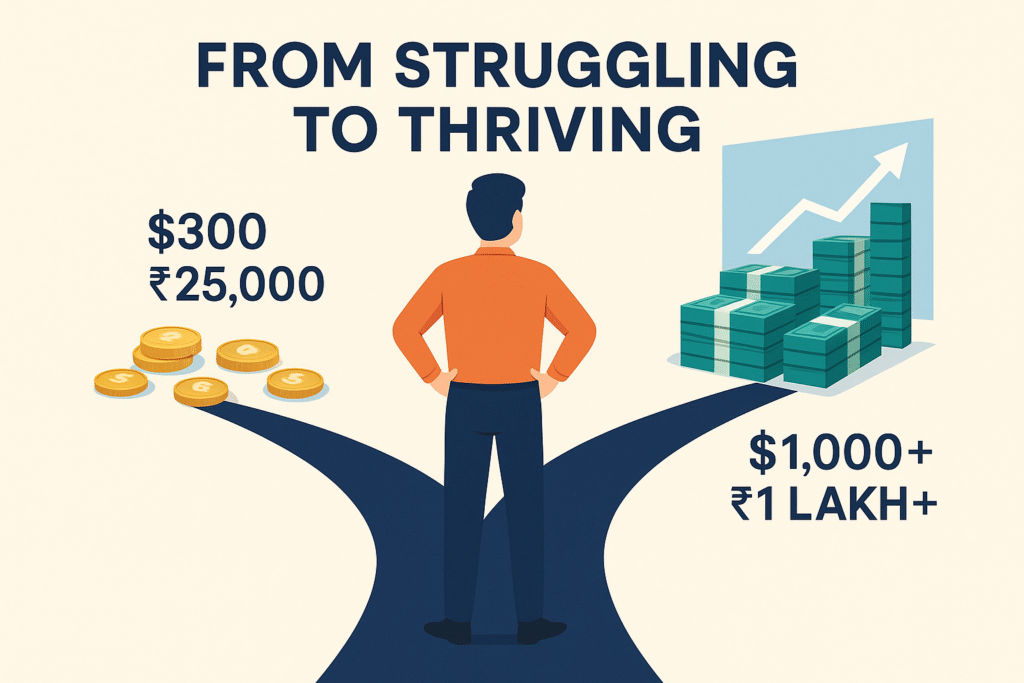
    The Simple Way to Earn More When Your Income Isn’t Enough

    More than 90% of people in India earn less than ₹25,000 per month (around $300).

    Only 3–5% earn above ₹1 lakh (about $1,200).

    But this is not just India. Globally too, most people are stuck under $300–$500 a month, and only a few cross $1,000+.

    Still, you too can go from ₹1 lakh or $1,000 to multiple lakhs or thousands every month.

    I have personally followed a process and generated this kind of income.

    Stay with me till the end of this post, and I’ll share that process in detail.

    (Video version here 👉 Watch on YouTube)

    Two Simple Paths to Create More Income

    When I talk about process, I mean two things:

    1. What you can do alongside your existing job.
    2. What you can add on as a new stream.

    Want to know your best starting point? Take my free quiz here:
    link.drashishjuneja.com/quiz

    Method 1: Offer Services

    The first method is to start offering services.

    Even in your job right now, you are already providing a service.

    You might think: “Won’t this become a second job?”

    Yes, maybe. But don’t worry about that right now. Once you find the right process and start earning more than your main job, you can quit the first one.

    My Example: LinkedIn Branding Services

    A few months ago, I offered LinkedIn branding services.

    I created content for people, helped with personal branding, and generated leads.

    For this, I charged ₹40,000 per client (around $500). I usually worked with 4–5 clients at a time.

    That came to about ₹1.6 lakh ($2,000) in a month.

    Later, I stopped because my passion since 2017 has always been coaching.

    Curious what services fit your skills? Take my quiz here:
    link.drashishjuneja.com/quiz

    What Services Can You Offer?

    Think about your domain. There is always extra work possible:

    • HR → Start HR consulting.
    • Sales → Offer sales consulting or training.
    • Marketing → Provide marketing consulting or training.
    • Academics → Thesis support, content writing, visiting lectures.

    When I was in academics, I often got thesis-writing work, content writing projects, and visiting lecture opportunities.

    Look into your own domain and see what extra you can do.

    Method 2: Learn High-Paying Skills

    We live in the internet age.

    Just search on ChatGPT or anywhere: “most sellable skills right now” or “future high-paying skills.”

    Some of the top high-paying skills today are:

    • Copywriting
    • Affiliate Marketing
    • Digital Marketing

    These are powerful because you can either use them for yourself or offer them as services to others.

    Method 3: Teaching, Training, Coaching, Consulting

    This is my favorite.

    Here you can productize your expertise and share it with others.

    There are three models:

    1. Low-Ticket Courses

    If you have expertise in sales, HR, pharma, or marketing, make a short course.

    • Keep the price under ₹10,000 (around $120).
    • Even ₹3,000–₹4,000 (about $35–$50) works very well in India.
    • Record your domain knowledge.
    • Add value with industry examples.

    Even 10 sales of a ₹10,000 course (about $120) = ₹1 lakh (around $1,200).

    Even 10 sales of a ₹3,000 course (about $35) = ₹30,000 (around $360).

    Don’t overthink. If you lack ideas, ask ChatGPT. Alternatively, you can book a one-to-one call with me. I’ll help you find the right course idea.

    2. Mid-Ticket Courses

    Anything under ₹90,000 (around $1,000) is mid-ticket.

    If you believe people will buy your course at ₹50,000–₹90,000, go for it.

    But if you’re just starting, stick with low-ticket courses first. Build confidence and grow your base.

    3. E-books and Small Products

    Another option is writing an e-book.

    I know people selling $10–$20 e-books on Gumroad.

    Start by publishing content on Medium or Substack. Build visibility, then offer your e-book.

    At the end of your articles, simply say: “This entire process is explained in my book.”

    People will buy.

    My Example: NISM Videos

    On my YouTube channel, I uploaded videos for the NISM (mutual fund distributor exam). Out of 12 chapters, I uploaded 8–9 as free videos.

    Below those videos, I added a link to a ₹199 (about $2.50) one-pager product. I didn’t even mention it in the video — just quietly placed the link.

    Students watched the free videos, clicked the link, and bought the product automatically.

    Till now, without active selling, that ₹199 (about $2.50) product has brought me ₹9,000–₹10,000 (around $110–$120).

    That’s exactly how you too can start small and grow.

    Final Thoughts

    You don’t need to make a big leap at once.

    Start with services, pick a high-paying skill, or create a small product like a course or e-book.

    Even ₹30,000 (about $360) extra income can change your confidence.

    Once you master the process, earning a ₹25,000 (around $300) salary is just the beginning.

    Increasing your income to ₹1 lakh+ per month (about $1,200+) becomes realistic.

    If you’re serious about making this jump, start by taking the quiz here:link.drashishjuneja.com/quiz

    Monetize your expertise. That’s the key.

  • Content Creation Doesn’t Make Money (Here’s What Actually Does)

    Content Creation Doesn’t Make Money (Here’s What Actually Does)

    These are the lessons from my creator journey. if I had followed them from the start, would have made my growth much faster.

    The work would have been easier and results would have been better.

    I wouldn’t have faced the detours that slowed me down.

    How It All Started in 2017

    My digital coaching and training journey began in 2017.

    At that time, I was running a coaching institute where we prepared people for government jobs.

    It had been running from 2014 to 2017.

    In 2017, I discovered something revolutionary. It was the internet and the “make money online” space.

    I found the first mentor Pardeep Goyal from Cash Overflow website.

    I visited his site, downloaded a PDF, and dove into blogging and affiliate marketing.

    Though the affiliate marketing course didn’t work out much, it clarified an important mindset shift.

    I was already in education and running an institute, one thing became crystal clear.

    In traditional work—whether it’s a job or business—you have to show up and deliver again and again.

    If you complete a task today, you’ll have to do it again tomorrow, and the day after, and so on.

    But what if there was a way to work once? You could get results for a lifetime or at least for a long time.

    That’s when I discovered the online space.

    Online, especially in teaching or content creation, you create content once and earn. There is a lifetime earning in some cases.

    The videos of mine—they work again and again.

    My First Big Mistake: Lack of Focus

    I started in 2017 and After connecting with mentors, I created blogs.

    My first blog was OneLifeToSuccess.com, which existed for some time before disappearing.

    I also connected with another mentor, Siddharth Rajsekhar, who hosted Monday webinars in 2017. At that time Siddharth was promoting GetResponse.

    When no one was using Zoom, he explained on zoom how online business worked.

    But here’s the most important point: if you don’t build focus, you’ll lose the long-term race.

    My focus was scattered.

    Motivation seemed like a natural niche to work in.

    I enjoyed motivating people and sharing insights. I thought the motivation and personal development niche would work.

    That’s why I named my first website OneLifeToSuccess.com.

    For the next two years, I wrote extensively on OneLifeToSuccess.com and similar websites—maybe 20-30 blog posts or even more.

    Those posts didn’t generate any income because I didn’t understand how money is made online.

    I only knew I had to create content and somehow money would come from it.

    The Truth About Content and Money

    Many creators starting now face this same misconception.

    If you’re beginning because someone told you to “create content wait.

    “create content, create content,” is the buzzword.

    This is for you – content creation alone doesn’t bring money.

    Money comes from monetization strategies.

    To monetize, there are three main methods which I say:

    1. Relying on someone else product (adsense)

    2. Providing services

    3. Teaching, Training, Coaching and Consulting

    (I have a previous video about this—I’ll link it—about the fastest way to make $1,000 to $3,000).

    Most creators I mentor are still focused on platform monetization.

    “Facebook will get monetized,” or “YouTube monetization will bring money” this is what they think.

    While Facebook and YouTube monetization can pay you, they can’t pay large amounts.

    Large amounts will occur only with big traffic.

    Why do I call it small money?

    When an ad runs on your channel, YouTube only shares about 55% of the revenue with you.

    That doesn’t scale significantly unless you have a big channel.

    My current channel has 1.2K subscribers on YouTube.

    My youtube adsense say $5.79 earnings but it cannot be paid as youtube is not monetized.

    This same channel has already generated $1,500 to $2,000 through from youtube only.

    In my case monetization earnings are too low as compared to non monetization earnings.

    this happened due to right approach monetization beyond monetization (MBM).

    The Real Problem with Motivation Content

    When starting, don’t fall into the trap of creating content without strategy.

    The motivation and inspiration niche can inspire people. However, it may delay earnings in your bank account. This happens unless you know the process.

    You become great at motivating others, people feel good consuming your content, but you don’t make money from it.

    When you’re in this cycle, you don’t see the big picture—only the small picture.

    You consume someone’s content, start creating similar content, and when nothing happens , your morale drops.

    There is money in every field, including motivation.

    The problem is: do you know how money will be made in your niche?

    If you don’t know how money will be generated, you need to figure that out first.

    When I Finally Found What Works

    In my journey, I created content in personal development for two years, focusing on content creation.

    Monetization didn’t happen because I didn’t understand monetization strategies.

    I thought I’d create content and earn from YouTube AdSense on youtube or Google AdSense on my blog.

    But I realized that without a solid system, success wouldn’t come.

    A real solid system isn’t about depending on platforms or providing services.

    The real third option is having your own coaching, training, teaching, or consulting program.

    Right now, I’m talking to you through this content without direct payment.

    But I do get paid when we talk one-on-one.

    After you consume my content, I invite you to book individual calls with me.

    To reach $1,000 to $3,000 monthly (₹1 lakh to ₹3 lakh), you need to follow what I call method number three. This method includes courses. It also involves coaching and consulting.

    This involves different price points—low ticket, mid ticket, high ticket—but requires focused execution.

    My First Real Success Story

    Let me share my first major breakthrough.

    While I had sold some courses before, my real success came through an unexpected Upwork experience.

    I found a writing project worth $30 and pitched for it, but didn’t get selected.

    I got frustrated, I realized I had already researched the topic they wanted.

    An idea struck me: if they were paying $30 for this content, why not create it anyway? I already knew what to write. So I created the content, and that $30 worth of effort ended up generating $300.

    For the first time, something showed real results on my OneLifeToSuccess blog.

    Here’s why it worked:

    The content was about “Best PLR Sites” and “Best PLR Sites in 2021” (actually 2021). PLR stands for Private Label Rights—content you can use as your own without ownership issues.

    Many coaches and trainers use PLR content with their own branding.

    I researched and analyzed 10-15 PLR websites, providing detailed comparisons and affiliate links.

    Readers clicked through to buy PLR products—whether $10 packages or $450 bundles, I earned 30-40% commissions.

    From that single piece of content, I made $30 (about ₹2700) from 2-3 hours of work. The same content worked for me till 2023 – till my site was existing.

    The content also performed well on Quora, bringing sustained traffic and sales over time.

    What Actually Works for Content Creation

    Many creators struggle with content ideas and run out of things to say.

    Here’s what I learned: the more I avoided talking to people, the more I struggled with content creation.

    My YouTube channel has 400+ videos, including many where I simply summarized books like “How to Get Rich.”

    While these got views, they didn’t generate real results.

    Real results came from three things:

    1. Clarity about direction
    2. Understanding monetization
    3. Working with people to generate content ideas

    Content created from your own mind often doesn’t work.

    Content based on people’s actual problems does work.

    All my current videos stem from ideas I get during Zoom coaching calls.

    During my zoom calls people share their pains points and where they are stuck.

    These conversations generate content ideas and they work because they address real problems.

    Don’t Repeat My Mistakes

    Everyone learns through mistakes. Consider this: it took you 21 years to earn your first income.

    You completed your education, then started earning .

    When you started your first job, you didn’t know what to do, but became expert at it.

    The creator’s journey is similar. I always say “monetize your expertise.” To move forward, you need to do one thing: monetize what you already know.

    My mistake was not monetizing my expertise.

    I thought I was good at speaking, so motivation would work.

    I saw motivational content on YouTube and thought I could do the same. But money wasn’t made.

    Money was made when I focused on personal coaching, training, teaching, and consulting programs.

    The Real Way Forward

    If you’re starting your journey and find monetizing motivation or inspiration challenging, here’s my recommendation: think about where money will come from first.

    Don’t assume you’ll post content and money will appear.

    If someone told you about YouTube AdSense or Google AdSense, understand that while money will come, you first need to meet requirements (4,000 watch hours for YouTube, AdSense approval for blogs).

    Even then, the money won’t be as much as you might expect.

    You can earn more through what I call the “CASH model.”

    Coaching, affiliate marketing, services, and high-ticket offerings.

    Even $1,000 monthly equals about ₹90,000—we’re talking about ₹1-4 lakh per month potential.

    Take Action

    If you’re starting your coaching or creator journey, plan your monetization strategy first.

    Do not fail at your efforts.

    I offer free one-to-one calls where I’ll understand your situation and chart out your complete journey map.

    If interested, you can work with me personally in my 90-Day Monetization Accelerator (two slots available this month).

    Make your journey short, not long.

    Learn from others’ experiences.

    What took me two years to learn, you can learn in two hours—with the right mentor, opportunity, and system.

    I’ve been working since 2017, but real results happened from 2024 onwards.

    Those seven years of trial and error can be condensed into 90 days with focused guidance.

    Book a call, let’s connect one-to-one, discuss your situation, and plan your path forward.

  • The Day Everything Went Wrong (And Why I Now Hope My Students Fail)

    The Day Everything Went Wrong (And Why I Now Hope My Students Fail)

    When Your Worst Day Becomes Your Best Teacher

    Few days ago I was conducting a LIVE digital Chai session that was scheduled at 9 AM sharp.

    Everything crashed.

    Internet failed.

    Technology completely gave up on me.

    Murphy’s Law in action: “Anything that can go wrong, will go wrong.”

    I had two choices:

    1. Cancel and disappoint everyone waiting
    2. Fight through it

    I chose to fight.

    So I decided to change the LIVE to 6 PM.

    I Went live at 6 PM instead.

    Here’s what hit me:

    Everything seems easy.

    The moment you start something You’ll get beginner’s luck first.

    Then Murphy strikes. Hard.

    Murphy law “Anything that can go wrong, will go wrong.”

    The people who succeed? They choose to keep going.

    The ones who quit? They’re still stuck in the same job, complaining about money.

    Which person will you be?

    99% of People Pick the Wrong Online Business Topic

    Most people jump into “making money online” backwards.

    They ask: “What makes the most money?”

    Wrong question.

    They copy what everyone else does.

    Wrong move.

    They try to help “everyone.”

    Wrong approach.

    Here’s the truth: The riches are in the niches.

    Let me show you what I mean…

    The Baby Powder Secret

    Nestle doesn’t sell baby powder to “all parents.”

    Think about it:

    • All parents = Millions of people = Impossible to reach everyone
    • New parents = Still hundreds of thousands = Too broad
    • New mothers with babies 0-6 months = Specific group = Easy to help

    The magic: The smaller your group, the easier it becomes to help them.

    The result: They pay you more because you understand their exact problem.

    This is why I don’t help “everyone make money online.”

    I help professionals, creators, coaches, trainers who want to monetize their expertise online.

    I help working professionals who want secondary income without quitting their jobs.

    Big difference. Huge results.

    The ₹500 vs ₹15,000 Medical Reality

    Your family doctor charges ₹500 for a 10-minute consultation.

    Your heart specialist charges ₹15,000 for a comprehensive cardiac evaluation (same time investment).

    Why the 30x difference?

    The family doctor gives general health advice.

    The specialist provides: detailed cardiac assessment, ECG analysis, risk evaluation, and personalized treatment protocol.

    One tries to help everyone with everything.

    The other dominates cardiac care completely.

    Same rule online:

    • “Health coach” = Low prices, lots of competition
    • “Weight loss coach for working mothers” = High prices, less competition

    The question: Do you want to be the ₹500 person or the ₹10,000 person?

    My 4-Question Formula (Worth ₹50,000 in Saved Mistakes)

    I learned this the hard way. Made every mistake possible.

    Cost me years and thousands of rupees.

    Now I use these 4 questions (based on the Japanese Ikigai concept):

    Question 1: What Are You Actually Good At? (Personal Analysis for me)

    Not what you think you should be good at?

    What people already ask you for help with.

    My honest answer: Online strategy, business consultation, LinkedIn branding, digital coaching, affiliate marketing

    Question 2: What Could You Do All Day Without Getting Bored?

    If money wasn’t a factor, what would you choose to do?

    My truth: Talk about making money online, teach people, create helpful content, build communities

    Question 3: What Problem Makes You Angry When You See It?

    What frustrates you about the world that you want to fix?

    What bothers me: Smart working people stuck in jobs, wanting more income but scared to start online

    Question 4: What Would People Pay You For Right Now?

    Be honest. What could you charge for today?

    My reality: Digital coaching, affiliate marketing, LinkedIn help, online business consultation.

    The breakthrough moment: Look for what appears in ALL four answers.

    For me? Helping professionals create digital income.

    That became my niche.

    The 732,000 Person Proof

    But how do I know people want my topic?

    Don’t guess. Research.

    Tool 1: Google Trends

    • Search your topic
    • Look for numbers above 50
    • Check if it’s growing or dying

    Example: “ChatGPT” exploded since 2023. “Weight loss” stays steady year-round.

    Tool 2: YouTube Detective Work

    • Search your topic
    • Videos with 50,000+ views = good demand
    • New videos posted weekly = active market

    Tool 3: Facebook Groups (The Gold Mine)

    • Search groups about your topic
    • ChatGPT community: 732,000 members!
    • Multiple big groups = people will pay

    My group: Digital Chai Club – join us there too.

    Check Google Trends for your topics

    • Search YouTube for demand
    • Find 3 Facebook groups
    • Pick your most specific topic
    • Join digitalchai.in community
    • Post your chosen niche for feedback

    Next 10 minutes:

    Message me in the community. I’ll help you refine it.

    Start creating content around your topic.

    You’ll have clarity others spend years trying to find.

    Real member testimonial: “What amazing 1.5 hours ❤️❤️ I have been with a lot of coaches, most of them were too professional…but Dr. Ashish literally went into my personal life to find what exactly can I deliver to the society. It was more like a reflection of my life. I took almost 1.5 hours, although the call was scheduled only for 30 mins.”Verified Trustpilot Review

    Join now at digitalchai.in FREE community now.

    The Choice That Changes Everything

    Right now, you’re at a crossroads.

    Path 1: Close this post. Go back to your regular day. Keep wondering “what if.” Stay stuck in the same financial situation.

    Path 2: Take 5 minutes. Answer the questions. Join our community. Start your journey to secondary income.

    Most people will choose Path 1. They’ll make excuses. “I don’t have time.” “I’ll do it later.” “It won’t work for me.”

    The few who choose Path 2? They’ll be earning extra income while others are still making excuses.

    Three months from now, one of these will be true:

    • You’ll wish you had started today
    • You’ll be grateful you started today

    The people who take action get the results. The people who wait get the regrets.

    What’s it going to be?

    Your Next 40 Seconds

    Don’t think. Just do:

    1. Go to digitalchai.in (30 seconds)
    2. Message me your chosen niche (10 seconds)

    That’s it. Your secondary income journey starts now.

    Digital Chai Club- Where Professionals Monetize their expertise online.

    Which future do you want?

  • Not In Sales? Unlock The Astonishing Secret To Massive Success

    You’re Not in Sales? Discover the Secret to Monetizing Your Skills and Building Wealth

    You are in a meeting and sharing a new idea.

    You are not sharing, you are selling a vision.

    Whether you like it or not you are selling yourself all the time. Jobs, dates, interviews, meetings. Every conversation, every interaction with a human …” Damian Prosalendis

    Do you think Sales is only for people with targets and cold calls?

    Think again.

    Every day, you are selling your ideas, skills, time, and experience in your office.

    If the word selling feels uncomfortable to you, you are not alone.

    A few years ago, like you, I felt, “I am not in sales; I do my job.”

    The Truth?

    Selling is the secret ingredient in every successful career.

    When you accept it, you don’t just survive, you thrive with selling.

    Selling is only for Sales People – You are Selling Your Skills

    Most professionals believe selling is only for salespeople.

    “Your job as a CEO, Chief Sales Officer. ‘If we’re all gonna eat, somebody’s gotta sell.’”

    Codie Sanchez

    Many feel uncomfortable or even “wrong” about selling themselves at work.

    I was talking to a teacher in my Digital Coaching mentoring session. She said, “Sir, I can’t ask for money I am a teacher, and my job pays me.”

    What she meant was – she doesn’t want to sell to anyone.

    When you believe sales is for salespeople and not you!

    Your mindset creates missed opportunities.

    The bigger impact is on the ignored ideas, lost promotion, and recognition.

    “You think, ‘Selling isn’t for me- I just do my job.’ But this belief is holding you back. Every day you avoid selling your skills, your value goes unnoticed.”

    The Champion Salesman

    The biggest problem you are facing right now is not being recognized.

    This leads to stagnation and frustration.

    When you are not recognized at work, there is a constant struggle deep inside, even after work hours.

    You are always looking to create value even beyond your work hours.

    You are learning and gathering more information, speaking to people.

    Your only goal is that your idea is accepted and you are appreciated.

    I remember while working at the University. After coming home, I was always in search of something. I wanted to increase my value.

    In the university system, it is more publications, attending conferences, and seminars.

    You will face what I faced until you understand and recognize that selling is about communicating value.

    Your time, skills, knowledge, and ability are missing just one thing.

    You are not sharing your work with your boss or superior. Your belief is, “Let him know that I worked on a project and I am busy doing my work.”

    I was in a similar boat: “I am doing my work. The boss knows everything. What is the point of going and telling him? I did this and I did that.”

    Understand that he is the boss for you and others too.

    You know your work and assume whatever you are doing is being noticed. You are right, sooner or later it will be known, but what if it becomes late?

    A simple shift can change your life.

    Understand – You are selling.

    In the jo,b you are selling your:

    1. Skills
    2. Knowledge
    3. Aptitude
    4. Experience
    5. Time
    6. Efforts

    When doing the above, add one thing and you will be recognized.

    Mindset: “I have to sell.”

    The game will change for you in your office.

    Your job is to

    1. Do the work
    2. Communicate what you did.

    I missed point 2 and suffered once. I was working with a one-person company, and I assumed my top boss knew everything.

    I focused on my work and was not good at reporting and finding reasons to meet the top boss.

    When you miss the communication, a few others start playing between.

    The communication goes around, not straight.

    Just changing your mindset will help you create wonders in your office.

    This will help you to get some time for yourself beyond your job and peace of mind.

    Use that to build:

    1. Side Hustle
    2. Coaching Business
    3. Affiliate Marketing
    4. Start a Service

    Transformation

    Imagine feeling recognized and having ample time to work on your passion.

    The feeling of empowerment and value will set you in motion.

    “I have fully stepped into what I want to do in this life and it feels a little wild that I figured it out so young, but I get people hired PERIOD. And not just …”

    Andrea (@andreaisawriter)

    Once you know, every time you are selling something.

    This will become a game for you.

    You have to do two things

    1. Recognize a product/service
    2. Market and sell that product/service.

    A simple mindset will change your growth trajectory in your job.

    Your passion/side hustle beyond your Job

    Start Your Sales

    For you to create a side hustle beyond your work hours, I have created a course.

    Worth $100 – 7 Days to Digital Business I am offering for FREE to the first 100 People.

    Stop dreaming about monetizing your skills and start earning from your knowledge.

    Join the “7 Days to Digital Business” program and get a step-by-step roadmap.

    Turn your skill, interests, and experience into real income- no prior experience or technical background.

    In one week, you’ll:

    • Find your most profitable niche-even if you think you have “nothing to sell.”
    • Learn how to create digital products and services that people want.
    • Do not rely on donations or unpredictable YouTube revenue.
    • Build your own digital business from scratch.
    • Use proven strategies that have helped over 100 students.
    • Reach their first ₹50K month and beyond.

    Discover how to leverage your skills for new career opportunities

    Walk away with a ready-to-launch digital business.

    I am a digital coach who has helped countless beginners, creators, and founders build thriving online businesses.

    Enroll now if you’re tired of wasting time on scattered YouTube advice and want a focused, actionable system.

    Transform your knowledge into your most valuable asset.

    Don’t wait- take control of your future and start building your digital business today.

    7 Days to Digital Business

    This is your moment if you’re ready to stop waiting and start building.

    Enroll in the “7 Days to Digital Business” program now.

    Take the first step toward turning your knowledge, skills, and interests into a profitable digital business.

    You don’t need prior experience or a technical background.

    Just the willingness to take action and follow the proven steps inside the course.

    In one week, you’ll have a blueprint, a niche, and the confidence to launch your digital business.

    Attract clients, and open up new career and freelance opportunities.

    Don’t let another week go by wondering “what if.”

    Join over 100 others who have already transformed their future.

    Click “Enroll Now” and start your journey to digital freedom today.

    Conclusion

    You think, “Selling isn’t for me- I just do my job.” But as Damian Prosalendis says, “Whether you like it or not you are selling yourself all the time. Jobs, dates, interviews, meetings. Every conversation, every interaction with a human …”

    Even leaders know this truth. Codie Sanchez reminds us, “If we’re all gonna eat, somebody’s gotta sell.”

    You open new doors when you step into your value. Communicating your value is key. Andrea illustrates this perfectly. She says, “I have fully stepped into what I want to do in this life … I get people hired, period.”

    Selling is not just about products or quotas- it’s about communicating your value.

    Change your mindset every single day, in every interaction at work. Instead of thinking, “I’m doing my job,” think, “I am selling my skills, knowledge, and experience.”

    This unlocks a new level of recognition. You also gain influence and opportunity.

    You’ve learned that the discomfort around selling is common.

    Nonetheless, it’s also a barrier that holds many professionals back. This prevents them from the growth and acknowledgment they deserve.

    You set yourself apart by embracing the idea that you are always selling your ideas in a meeting. Your skill contributes to a team, and your time dedicated to a project makes you stand out.

    You become proactive, not just in doing great work, but in ensuring that work is seen and valued.

    The benefits are clear: greater recognition, more advancement opportunities, and a boost in confidence and job satisfaction.

    But it doesn’t stop at your day job. When you master selling yourself, you open doors to side hustles.

    You can also start digital businesses and create new streams of income. These opportunities can transform your future.

    Remember, the slight shift from “doing” to “doing and communicating” is the secret ingredient in every successful career.

    Don’t let your hard work go unnoticed.

    Make selling your mindset, and watch how your career and your life change for the better.

    Now, take action. Start sharing your wins.

    Communicate your value. If you’re ready to build something beyond your job, join the “7 Days to Digital Business” program.

    Your next level of growth begins with the decision.

  • Do Not Quit Your Job – Do This Instead

    Do Not Quit Your Job – Do This Instead

    I should quit the job and take the lead.

    You have heard that sailing in two boats will not help you. You only want to be on one boat.

    You are thinking right, but a few things will not stop.

    1. Bills you have to pay every month
    2. The EMis you have taken

    The above two things do not allow you to take action. Come what may, whatever happens in your job, you have decided to leave it in the next three months.

    The reasons could be:

    1. Self-respect
    2. Office politics
    3. The work is not to your liking.

    Very few people on this earth work in their interest.

    Only a few can do the work they like. Others are doing the job of paying the bills.

    There are responsibilities on your head that do not allow you to take action.

    Your income can stop, but your expenses will not.

    You are lured by the actions taken by the people and getting successful.

    When you cannot leave the job, what is the solution?

    Build Digital Business beyond work hours

    The solution is to build your Business after work hours. The Internet is the most significant opportunity of this century. During work hours, work on the job that pays your bills. After office hours, work on the dreams that fuel your passion.

    A few years ago, people had few options only that including:

    1. MLM -Multi-level marketing (Networking marketing )
    2. A part-time second job after work hours.
    3. A part-time business from family/self-employment arising out of insurance business etc.

    Today, we live in an information and internet age. You need to decide your niche and work on your goals and process.

    Steps to create secondary Income with your job.

    1. Identify your niche/expertise area. Learn high-value skills such as copywriting, ghostwriting, social media marketing, and sales. Identify the high-value skill as per your area of interest.
    2. Practice the high-value skill with people—Regardless of your area of interest, you can practice it with people who can pay for it.
    3. Create recurring revenue from high-value skills and practice.

    There are three main Niches for which people can pay you money.

    Identify one Niche that you can serve out of

    1. Health
    2. Wealth
    3. Relationship

    Choose a Niche that connects with your backstory. If you are in excellent health, you can go with health.

    If you have an excellent relationship, go with that.

    If you have wealth, go with that.

    The primary premise is that it should be my area of interest, and I should have a background in it.

    Refer to when you faced a challenge in any of the niches above and later utilized a system that helped you grow in that Niche.

    There is a saying- your Iche becomes your niche.

    The solution you searched for is to become your process for helping others overcome the same problem.

    Once you have chosen the niche, you can create the Digital Business around that:

    1. Start servicing the people in the Niche. Many people are struggling and undergoing the same pain that you experienced when you struggled. Show them the path and help them overcome that pain/problem with your unique solution. For example, if your salary is 100K INR, two clients of 50K will replace your job.
    2. Create courses around that topic. Not everyone can pay you for the service you want to deliver. Record the process and share it with people who want to meet results. This recorded process can serve as your digital course.
    3. Create an ebook around the niche/topic—Whatever you know, if you can create an ebook around the topic, you can win big in the game.

    Witness the transformation

    Many people come to me for the solution when they want to leave the job immediately.

    I tell them only one thing. 

    What are the least expenses per month you need to pay bills?

    Do you have the least savings to pay your bills for at least one year?

    If your answer is yes, you may decide to take the full-time jump

    If you still struggle to pay your bills, do not consider leaving the job.

    Imagine creating a business with your using only

    1. Writing
    2. Personal Branding
    3. Content marketing

    These three things can help you generate high-paying clients who pay recurring bills. This can also land you unknown opportunities, course takers, books, and subscriptions.

    It might take some time, but it is not a distant reality.

    7 Days to Digital Business

    Take the FREE 7 days to digital Business program and launch your digital business.

    You can book a consultation if you are unclear about your niche and want to identify it.

  • Why Being Resourceful Is The Greatest Asset

    Why Being Resourceful Is The Greatest Asset

    The path to being resourceful and “I am Self Made” is the journey where you face challenges get stuck, and there is no going back. You hit the problem hard, overcome it and declare to the world, “Here I am” bigger, better, louder with a bang.

    Hey, this is Ashish, and I want to welcome you to my world “officially.”
    About five years ago, in 2014, I started my Entrepreneurial Journey when I was working in a management Institute. Three months of my Salary was due. Day in and day out, I was thinking, “how will I manage my life? How will I manage my family?”

    My newborn Son, Mukund, was just nine months old. Every day I came home and said to myself… “Is this the life I will give to my family?” “Am I prepared for this?”

    Long story… short…

    I was struggling, and nothing was working out. I started sending my resume to many institutions left and right, but nothing was working out. With a colleague of mine, I had sent proposals for counseling to many Institutes, but nothing worked.

    One day I asked my distant friend, “Can you help me get a job in your place?”

    He said, “send me your resume and connect with me tomorrow.” I called him the next day, but the answer was nothing new, “there are no opportunities.”

    Then he said, “Can you join me?”

    I asked him, “What will I do?”

    He said, “whatever I am doing.”

    That was the turning point in life — my aha moment where I came to know about the power of Entrepreneurship. That is what an Entrepreneur is and his capacity to help and make money for him. Enquiring further, I came to know about selling the Franchisee of the Institute he was running. One sale was equivalent to $500 Value, 35000 INR, and two sales $1000, 70000 INR value. What a brilliant idea!

    1*obYxHv4h0LwVY8QtoK2cIg

    Wait

    What if I take the franchisee?

    “Three months of my Salary is already due — some amount I will take from Savings. The Franchisee cost is just $1000, and other expenditures will total to $2000–140000 INR. What if I take the franchisee?” Looking at the cost and revenue analysis, it is a brilliant idea to move from being an employee to become an employer.

    So, finally, I took a franchisee of the Institute. Starting up a coaching business, and this experience of mine became my obsession. I looked for many things to fuel my passion and look for all opportunities, and I became a student of “Resourcefulness.” I ventured into other activities where I test and try stuff out. Miracle Life and Mindset Coaching is where I share what I’ve learned.

    1*NyC1BVNPnbQFonVkfgUNRQ
    Photo by Nik MacMillan on Unsplash

    The story is not yet over. Within 15 days of starting up the Venture, while I was on the job with the Institute, my employer called me, and we had a long discussion.

    He said, “Ashish. A job is a 24 hours job. Notionally you are there for 8 hours only. Now, as you have opened up your venture, decide. Decide whether you want to be with us or you want to be fully there in your venture.”

    I was sitting in front of him on a Sunday afternoon, hearing and realizing all that he said. Now the only decision was to take it or leave it. And I left it. I became jobless.

    This was the start of my entrepreneurial journey. The journey of being “self-made.” The mission of being resourceful. The trip where you care every month about the employee’s bills and salaries. The journey of sitting in an office extra hour without thinking about how much I will be paid extra. The mission of no compensatory off. The journey of no fixed salary at the end of the month. The journey of being alone and trailing your path. The journey of conquering new and new challenges.

    Since 2014 the challenges are new, and life is not a straight line. There are no ups only but downs also, and that’s what life is. But the only thing that has created miracles in my life is “being resourceful.”

    “How did I get here?”

    1*itpAdE6O7ldkLqBqvW2ZTA
    Photo by Startup Stock Photos from Pexels

    I was sitting in my office two years ago (2017), feeling a little confused that after everything, it would all end here like this. I had been blindly following the physical coaching business and every other thing for almost ten years, moving towards one goal, only to find out that the whole thing was a lie.

    It would change someday…. Jobs are reducing, and the world is going totally digital.

    I looked to the left, and I moved to the right….and I felt many are in the same situation as me. They only have smiles on their faces. Didn’t they know what changes are happening in the Industry?

    It was Saturday, 30th September 2017. It was the day when I was having the lowest business of the month. “You need to build a business so that you can make a fortune.” Sure, there are a lot of celebrations whenever you start something new, but what about when that original is no more fresh and new.
    Sometimes we get the chance to meet the “Challenge and Change.”

    For many people who worked with me on jobs, they are still doing the job. Some others have had their business. The claims of business and sometimes a job can’t pay enough. When I looked around for people, it confused me. For me three years ago, I figured out a way to convert a situation into your favor.

    Miracle Mindset was how helped me move from Job to BUSINESS, from earning $500 a month to generate monthly annual revenue of $8000 for my business in 2014. Disclaimer — not that consistent since then and has reduced sharply to the lowest of my journey because of various external factors. That’s what a business is and dependent on.

    I was sitting in my office. Doing the maths and trying to figure out how much college professors make per day and month.

    I assumed they would make something around 500 dollars to 24 thousand dollars per year (May below may be high). As I was an Assistant Professor for ten years, so did the maths. Then I came across the article “People making $1000 a day” approx — 70000 INR. Here we are working for 1000–$2000 a month and people are making $1000 a day. I thought that was awesome.

    I was still doing the math, $1000 per day…. $30000 per month, and $360000 a year! But the craziest part is the person only spent a few hours/ day on developing a digital product, That’s it. The creator just created the product once and got paid for it repeatedly!

    That’s when I realized, and I do not want to sell things the usual way I was doing in Physical Coaching and as Assistant Professor…. I want to trade like digital Earners. And so that’s what I did. Focusing on selling mine and other people’s products, I generated the Income that was repeatable and recurring.

    I did all by focusing on ONE thing….

    I am selling my knowledge the right way! When I first became an “Affiliate,” I was concerned because I did not have any credentials, degrees, or anything…. I just knew what I realized, and practices worked, and I want to share it. But what caught me off guard was how helping people get what they want in life changed the quality of my life.

    Sure, I made money, BUT… each person I helped opened up new doors for me. But the real hidden benefit has been the fulfillment I get, when I see someone else change his or her life. And that is what this business is about for me. I’m guessing if you’re here, then it is probably the same thing for you Am I right?

    1*IkTNl4vtolgTaWviajLXeg

    The story doesn’t end there, and my business journey has been ever-evolving.
    I am continuing with the real coaching business but going more and more digital.

    In 2018 my wife said to me, “keep doing your physical business and keep working on your digital coachings and integrate them.” That was another aha moment.

    1*r0ZNCLhFb3aii2RRIf6IOw

    There have been many difficulties, and life will never be up only for anyone, but I know I have to be resourceful.

    In 2017, I restarted all learnings of Personal Development and Digital Business skills. It’s been a hidden desire to keep up the momentum and remain independent and inspired.

    Being Resourceful with Miracle Mindset, you can transform your life. Finding a mentor, Coach, reading the books, and self-help resources for your problem can help you grow. Having been mentored by Dr. Joe Vitale, Dr. Steve Jones, and many others, I feel new challenges would come up each day, but you have to become resourceful. Be, and there is no other option. I recommend finding a mentor or coach who you resonate with and trust and getting someone-on-one on one help (or at least get it in a group setting).

    If this has inspired you, connect or drop a comment. If you’d like more advice on Miracle Life and Mindset Coaching or anything else related to being an entrepreneur, let’s connect. Be Resourceful and create your Miracle Life and Mindset.