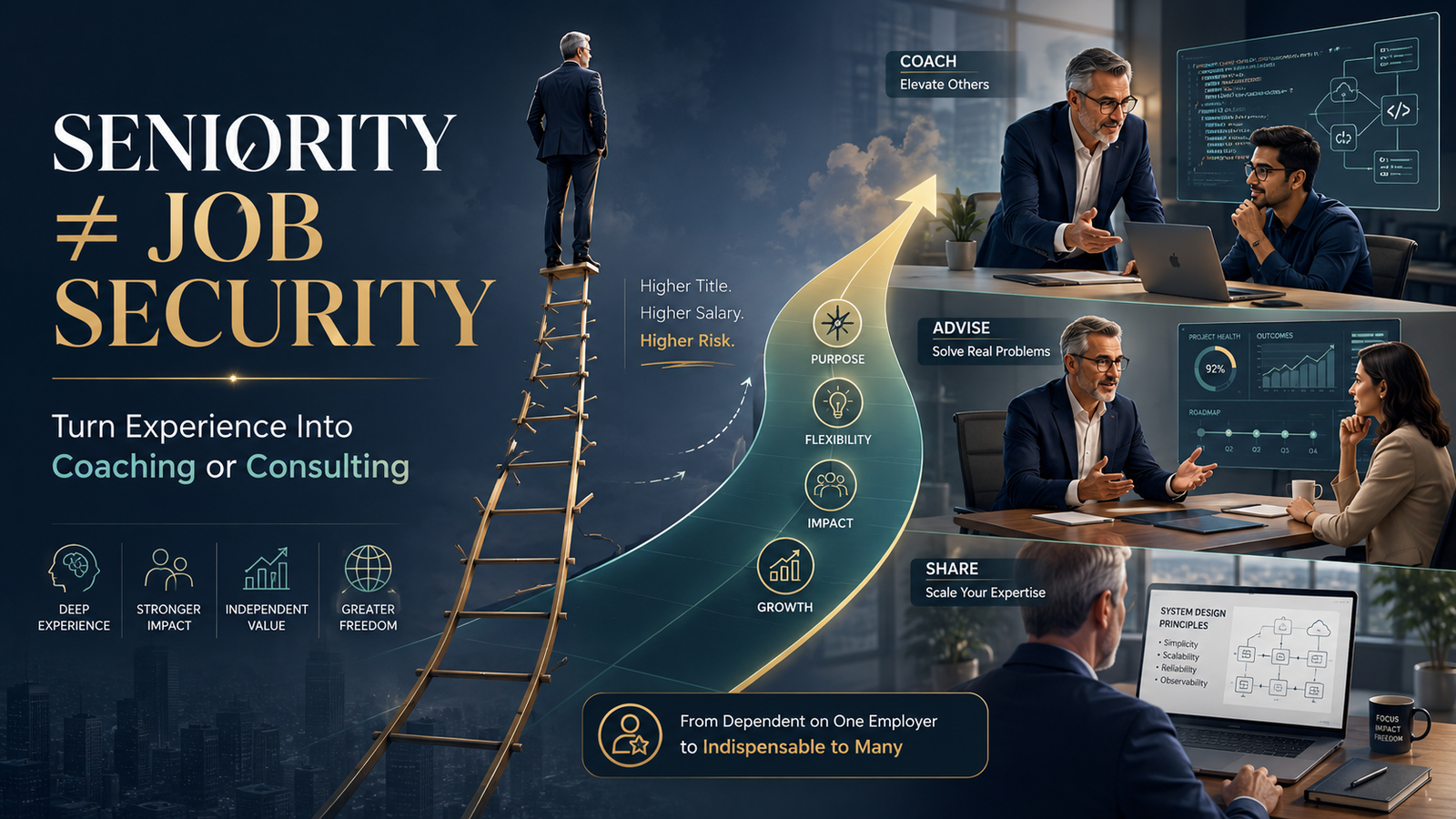
A senior job title does not protect you from a layoff.
The more senior you are, the more responsibility you carry, the higher the stakes in your decisions, and the higher is your salary.
You are among the few in the highest pay bracket, and that bracket is exactly what puts you at risk.
This article explains why seniority raises your layoff risk and lays out the alternative I actually recommend: converting your experience into a coaching or consulting model.
Why Seniors Are the First to Go
When an organization runs a cost-cutting effort, the first people selected are usually the senior ones because they sit at the higher payoff.
During a layoff, juniors don’t go first. It’s the seniors, because of their higher pay band.
It isn’t about how well you perform or what you do. It’s about the package you bring home.
Your results aren’t measured by cost and results alone anymore; they’re measured by cost and revenue to the organization. The higher your cost to the organization, the more load you represent.
What Happens When You Climb the Corporate Ladder
You might have done very well in the past. You might have given the organization your last ten years and climbed the corporate ladder, but because you climbed it, you’ve become “big” — and that creates two problems:
- There is very little room left for your own growth.
- The organization can replace you with someone from the team, elevate them, and motivate them with your role — while you remain a cost the organization can’t justify paying more to keep.
The senior you become, the higher the ranks you reach, the riskier your job becomes.
When an organization checks its cost-to-revenue or cost-to-output relationship, you’re usually at a disadvantage unless you’re at a level where replacing you would genuinely hurt the organization’s revenue, or you’re otherwise too critical to risk.
The Solution Most People Try and Why It Doesn’t Work
The solution available to you in the market, once you’re higher up the ladder, could be: look for another job, another senior corporate role, another pay raise, but whatever caused you to want to move in the first place — that story will continue in the next role too.
The Real Solution: Convert Your Experience Into Coaching or Consulting
If you’re mid-career or senior, with around 20 years of experience, the solution isn’t just to look for another job.
It’s to find the opportunity to start your own consulting or coaching model, built on your technology and leadership experience.
At the senior level, you have two things:
- Leadership — you know how to manage your team, run projects, and manage tasks.
- Technology — you’re good at your subject.
The Techno-Managerial Problem
If you’re in IT, there’s a specific problem that comes with seniority: the more senior you get, the less hands-on you are with the technology itself.
I’ve spoken personally with senior leaders in IT, and I’ve seen this concern come up again and again. People with 15–20 years of experience are asking themselves whether they should go back and rebuild their coding skills even as the market moves toward what’s being called “vibe coding.”
They want to go back to coding because they no longer feel hands-on. They feel like they’ve become “more managerial” because the role has become techno-managerial: the hands-on technical part is a small percentage of the job, while managing the team, the project, and the output is the majority.
In that role, you’re the face of the customer and the face of the organization. You’re the link between your developers and the outside party, the customer.
You’re a techno leader who understands what the customer wants, and you translate that understanding into direction for your developers.
Here’s the double bind: the more you improve your leadership skills, the higher up the ladder you go, but the more you lose touch with the fundamentals.
There’s a constant fear underneath that: if I lose the fundamentals, where do I go? Looking for another job doesn’t fix this, and your condition stays the same. The actual solution is to convert your knowledge into a coaching or consulting model.
Path One: Coaching
You Only Need to Be One Chapter Ahead
If you’re a techno-managerial professional with expertise in a specific technology, one path is coaching. You can help junior people —particularly those in your technology or early-career tech professionals —level up faster.
Ask yourself: whatever stage you reached in your last 15 years, can you help someone reach that same stage in eight?
What mistakes did you learn the hard way that you could guide someone else past, so they climb faster than you did?
If it took you 15 years to reach a certain salary or designation, can someone else get there in eight or less?
That’s seven years of someone else’s career you’re saving them. Anyone earlier in their career than you is someone you’re well-suited to teach.
The biggest question people ask themselves at this point is: how can I teach? The answer is you only need to be one chapter ahead.
There’s a story from the movie Catch Me If You Can. The main character became, among other things, a professor at a university, despite being a fraud rather than a real professor. When a committee eventually caught on and asked how he could teach a class at that level without being the real professor, he answered: “I was just one chapter ahead.”
If you’re at level 10 and someone else is at level one, you can coach anyone from level one through level nine because that’s exactly where they want to become you, and where they want to learn from you.
If you have self-doubt about this, remember: your story and your journey are what make you qualified.
Path Two: Consulting
Start With What’s Already Around You
The second path is consulting. In a techno-managerial role, there’s very little room left to grow inside your organization. So:
- Find organizations you can consult for on weekends.
- If you can’t start a paid model yet, start building relationships and testimonials by consulting for free.
- If you know someone at your level who’s stuck, offer them consultancy directly.
- To find out what kind of consulting projects are actually in demand, go to Upwork and search your technology or domain. That will show you what kinds of projects, technologies, and skills are currently required — which tells you what kind of consulting offer you can build, and gives you something concrete to start writing about.
A Real Example From My Own Coaching
I recently worked with a senior leader, one of my mentees, who was at a well-known IT company on a very good salary.
He came to me and said: “Ashish, I’ve seen your model, and I’ve heard you talk about monetizing your expertise. I don’t want to monetize my expertise; what I really want is to create visibility and impact. I’m looking for opportunities, and honestly I’m fearful about what’s going to happen to my future. At times I feel like I should go back to coding.” He was thoughtful and conscious about what to do and where to go, just uncertain.
In four sittings, we identified that he should speak publicly about a specific technology. What we focused on:
- Clarity (Niche Clarity, Systems Clarity, message clarity)
- His LinkedIn headline
- His LinkedIn About section
- Posting consistently on LinkedIn
Once he started posting consistently, he began getting comments on his posts; because of that, he got another opportunity at another organization.
If you understand your technology and you’re at a senior level, maybe director level, start writing about your story on LinkedIn.
Write about what you know. Write about what you’ve learned. That’s what brings you visibility. This person, who is in the data science space, got another opportunity and real visibility once he started posting.
Pick One Action
From everything above, I want you to pick one piece of action and apply it to your own situation.
If you want to monetize your expertise: I help mid-career IT professionals build a second income without quitting their jobs. I run a community called SIP- Second Income Professional. The SIP Challengers community is 100% free.
- Join the community.
- Take the challenges.
- See what’s already been done there.
- Take action.
Join Second Income Professional now at secondincomeprofessional.com.
Register for the latest masterclass or book a one-on-one Clarity call with me.
2 Responses
Your essay made good sense to me as you captured nuances well. Thank you for the practical tips.
Thank you, Dr Mehmet, for sharing your opinion here. Glad this resonated with you.