Planning your Skool sign up? Here’s the short answer. Skool costs $9/month (Hobby, 10% + $0.30 per sale) or $99/month (Pro, 2.9% + $0.30) with a 14-day free trial, and signing up takes two minutes. The India catch: your members pay in USD by card only. There is no UPI, no Razorpay and no net banking. Since August 2026 Skool can at least pay you out in INR. If most of your buyers are Indian, read on: I’ll show you the Skool alternatives I actually use and the take-rate math behind my decision.
👉 Still want Skool? Start your 14-day Skool free trial here
Disclosure: Some links in this post are affiliate/referral links (Skool, Communi, TagMango, Bunny.net). If you sign up through them I may earn a commission at no extra cost to you. My recommendation doesn’t change based on who pays me. The numbers below are the reason.
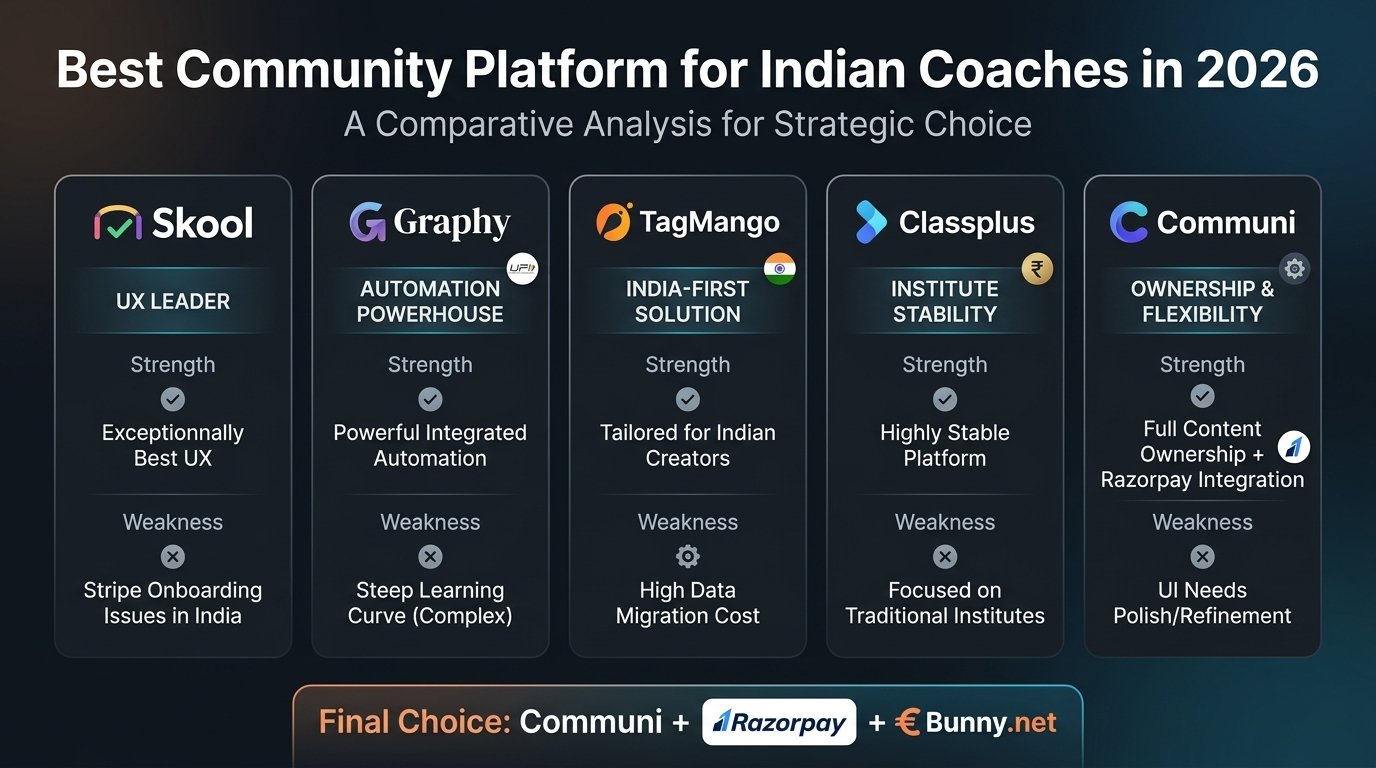
TL;DR: Which Platform Should You Choose?
| If you are… | Choose | Why |
|---|---|---|
| Selling mostly to Indian clients, community-first | Communi | 0% platform fee, flat yearly price, your own gateway |
| Selling to US/global/Middle East buyers | Skool | Best engagement UX, discovery network, card checkout is normal there |
| WhatsApp-first, running challenges | Nas.com (formerly Nas.io) | Paid WhatsApp communities built in |
| Starting fresh in India with an existing audience | TagMango | Native UPI/EMI, gateway included in commission |
| Scaling a course academy with automation | Graphy | Most feature-complete Indian LMS |
| Running a coaching institute (batches, parents, tests) | Classplus | Built for institutes, not communities |
My Starting Point
I didn’t just research these platforms; I built on them. My first community, “From Likes to Clients” (the Parallel Income Club), is a free Skool community for working professionals who want a parallel income by monetising their expertise. It has 50+ members: join it here. My first learning portal, learn.drashishjuneja.com, runs on Graphy and hosts my courses, booking flows and the “Become UNFIREABLE” program for corporate professionals.
Then my business evolved. Today I work with coaches and consultants who need consistent clients. I needed one platform that:
- takes Indian payments natively (UPI, net banking, cards),
- hosts community and courses together,
- runs on my own domain, and
- scales without bleeding ₹8,000–₹15,000 a month in subscriptions.
I tested payments on all of them, ran the numbers, and made my decision.
Comparison Table: Skool vs Communi vs Nas.com vs Graphy vs TagMango (Nov 2026)
| Feature | Communi (my choice) | Skool | Nas.com (Nas.io) | Graphy | TagMango |
|---|---|---|---|---|---|
| Pricing | $195–$495/yr ($27–$67/mo); lifetime deal ended when Communi switched to subscriptions; I’m on a legacy LTD | Hobby $9/mo, Pro $99/mo; 14-day trial | Pro $29/mo ($20.75 annual), Platinum $99/mo ($66.58 annual); 7-day trial; no free plan since Mar 2026 | ₹24,999 / ₹49,999 / ₹99,999 per year + GST | Basic ₹0; Pro ₹5,000/mo; Advanced ₹15,000/mo; Ultimate ₹30,000/mo; +₹24,999/yr for custom domain |
| Platform take-rate | 0% | 10% + $0.30 (Hobby); 2.9% + $0.30 (Pro, 3.9% above $900), processing included; 30% on Growth Boost members | India digital: 5.9% / 4.9% / 2.9% + 2.2% gateway + 18% GST on fees | 10% / 7.5% / 5% (min ₹10) | 10% / 5.5% / 3.5% / 0%, Indian gateway included |
| Indian payments | Native checkout is Stripe; I run Razorpay (UPI, net banking, cards) + Zapier | USD card checkout only; no UPI or Razorpay; INR payouts since Aug 2026 | UPI via Razorpay/Stripe India for India-based accounts (PAN + Indian bank); ₹1 lakh UPI cap | Native Indian gateways | Native Razorpay, UPI, EMI |
| Community | Feed + groups + chat + courses + events | Gamified feed, leaderboards, discovery | WhatsApp/Telegram/Discord-linked memberships, challenges, Magic Reach | LMS-first, community secondary | WhatsApp-centric; community channels on Advanced |
| Best for | Owned, low-overhead coaching hubs | Global creator communities | WhatsApp-first and challenge creators | High-volume course academies | India-first workshops and cohorts |
The Economist’s Math: Take-Rate at ₹1L and ₹5L per Month
Headline prices are misleading. What matters is the take-rate: everything the platform stack costs you as a percentage of revenue.
Assumptions (so you can redo this yourself):
- ₹88 = $1.
- Average ticket of ₹10,000, so 10 sales a month at ₹1L and 50 sales at ₹5L.
- Annual billing where offered.
- A 2% Razorpay-type gateway fee where the platform doesn’t include processing (Nas.com’s India gateway is 2.2%).
- Bunny.net video at ₹500/month on Communi.
- Every platform’s GST on fees is excluded, because a GST-registered business can usually claim it back as input credit.
| Platform & plan | Monthly cost at ₹5L revenue | Take-rate at ₹5L | Take-rate at ₹1L |
|---|---|---|---|
| Communi (my legacy LTD) | ₹10,500 | 2.1% | 2.5% |
| Communi PRO ($495/yr, new buyer) | ₹14,130 | 2.8% | 6.1% |
| Skool Pro | ₹24,532 | 4.9% | 11.9% |
| Nas.com Platinum (India) | ₹31,359 | 6.3% | 11.0% |
| Graphy Rise (gateway extra if charged) | ₹33,333 | 6.7% | 10.8%* |
| TagMango Pro + Freedom Setup | ₹34,583 | 6.9% | 12.1% |
| Nas.com Pro (India) | ₹37,326 | 7.5% | 8.9% |
| Skool Hobby | ₹52,112 | 10.4% | 11.1% |
At ₹1L, Graphy Launch (₹24,999/yr + 10%) is cheaper than Rise; TagMango Basic (₹0 + 10%) is cheaper than Pro.
What this means: at low revenue, fixed fees hurt most. Skool Pro takes almost 12% of a ₹1L month. At high revenue, percentage fees hurt most. A flat-fee platform with your own gateway wins both ways.
3-Year Total Cost of Ownership (₹5L/month revenue)
| Platform | 3-year all-in cost | Extra vs. Communi LTD |
|---|---|---|
| Communi (legacy LTD) | ₹3,78,000 | – |
| Communi PRO (annual) | ₹5,08,680 | +₹1,30,680 |
| Skool Pro | ₹8,83,152 | +₹5,05,152 |
| Nas.com Platinum | ₹11,28,924 | +₹7,50,924 |
| Graphy Rise | ₹11,99,988+ | +₹8,21,988 |
| TagMango Pro + Freedom | ₹12,44,988 | +₹8,66,988 |
| Skool Hobby | ₹18,76,032 | +₹14,98,032 |
Skool Pro’s subscription alone is about ₹3.1 lakh over three years, which is where my original “₹3,00,000 saved” figure came from. Once you add the transaction fees, the gap at ₹5L/month is over ₹5 lakh. That excludes the hidden cost of Indian buyers abandoning a USD card checkout.
Skool: Great Product, Wrong Checkout for India
My free Skool community is live, and Skool genuinely has the cleanest community UX on the market. It’s familiar, and its gamification and leaderboards drive real engagement. Courses and video sit inside the same product.
The problem was always payments. Skool processes everything on its own merchant account, so you can’t plug in Razorpay. People search “skool.com razorpay” for a reason: it doesn’t exist. For years Indian creators couldn’t even receive payouts. I never took a single payment on Skool; I collected on Razorpay and added members manually. 100% of my coaching and training payments have come from India.
What changed in 2026: Skool’s help center now says its new payout system “is currently rolled out for users in Colombia, India, Chile, Brazil, Mexico, Argentina, Peru, and Costa Rica.” Indian creators can “add an INR bank account,” with “no additional fees for currency conversion.” That’s real progress. But Skool’s own payments FAQ still says “All subscription prices on Skool are in USD. Members pay in USD.” For an Indian buyer that means:
- an international card,
- foreign-currency markup charges, and
- no UPI.
Skool pricing, precisely: Hobby is $9/mo at 10% + $0.30 per payment. Pro is $99/mo at 2.9% + $0.30, rising to 3.9% above $900. Annual billing gives two months free. Pro adds a custom URL and affiliates. Watch Growth Boost: it’s on by default and takes 30% of recurring revenue from members Skool’s discovery brings you.
Verdict: excellent for Western and Middle East audiences, and for free communities. Unworkable as my primary paid platform while my buyers pay by UPI. If Razorpay is enabled on Skool.com, I will switch to Skool immediately.
Nas.io (Nas.com): The WhatsApp-First Contender
I haven’t run a community on Nas.com. This section is my evaluation from public pricing, help-center documentation and user reviews, not first-hand testing.
What is it now? Nas.io rebranded to Nas.com in April 2026, and nas.io links now redirect there. Built by Nuseir Yassin (Nas Daily), it has pivoted from a community tool to an AI-first business platform for solopreneurs. The free plan ended in March 2026. Pro is $29/mo ($20.75 annual) and Platinum is $99/mo ($66.58 annual).
Where it shines:
- “Super WhatsApp” turns a WhatsApp group into a paid membership with automated joins, payments and broadcasts.
- Challenges, events and 1:1 sessions.
- Magic Reach messaging.
- AI ad tools.
If your audience lives on WhatsApp and you sell 14-day challenges, the Nas.io community model is genuinely clever.
The India economics: for India-based sellers of digital products, Nas.com’s help center lists a Nas fee of 5.9% (Basic), 4.9% (Pro) or 2.9% (Platinum), plus a 2.2% gateway fee, plus 18% GST on both fees, and TDS may be withheld at payout. UPI requires an India-based account with PAN and an Indian bank, and is capped at ₹1 lakh per transaction. Nas.com’s own payments page says recurring subscriptions use card methods, not UPI. Its pricing page headline says “0% Nas fee,” which contradicts the help-center tables, so get your rate in writing.
Nas.io reviews: Trustpilot lists 465 reviews for Nas.com, 73% of them five-star and 12% one-star, for an aggregate of about 4.2–4.3. Users praise ease of use and the challenge programmes. Complaints cluster around billing after cancellation and payouts held for compliance review.
Verdict: a strong Skool competitor for WhatsApp-first and global creators. For India-billed recurring memberships it costs 6–7.5% of revenue at ₹5L/month, roughly three times what I pay.
TagMango: The Strongest India-Built Option for Starting Fresh
TagMango is India-first:
- native Razorpay with UPI, cards, net banking and EMI,
- built-in WhatsApp marketing,
- live-session upsells,
- iOS/Android apps, and
- India-first support.
Its 2026 pricing is better than most comparison posts claim. Basic is ₹0 + 10%, and that commission includes the Indian gateway. Pro is ₹5,000/mo + 5.5%, Advanced ₹15,000/mo + 3.5% and Ultimate ₹30,000/mo + 0%. A custom domain needs the ₹24,999/yr Freedom Setup.
TagMango vs Skool: for Indian buyers TagMango wins on checkout, and Skool wins on community UX and global discovery.
Why I didn’t switch: migration cost. My infrastructure at digitaleconomics.academy already ranks on Google. The Inner Circle is live at ₹9,999/year, 12 course modules are structured, and Razorpay is tested. A rebuild would take 4–6 weeks. The opportunity cost of not running Revenue Clarity Sessions during that time is ₹40,000–₹60,000, and that’s before SEO loss. TagMango is also built for creator monetisation with large audiences, while my model is community-first and methodology-first.
Graphy: The Best Indian Platform for Scaling Courses
Graphy (Unacademy) powers my learning portal at learn.drashishjuneja.com for low-ticket products and courses. It’s the most feature-complete Indian platform:
- AI website builder and AI sales/support agents,
- large live rooms,
- WhatsApp cart recovery,
- white-label apps, and
- SEO-optimised course pages.
Current India pricing is Launch ₹24,999/yr (10%), Grow ₹49,999/yr (7.5%) and Rise ₹99,999/yr (5%), with a ₹10 minimum fee per sale, plus GST.
Graphy vs TagMango: Graphy has no free tier and is better for course catalogues. TagMango is cheaper to start and better for live cohorts. Graphy is overwhelming as a first community, which is why I keep my course portal (individual learners, low-ticket catalogue) separate from my community (coaches implementing together).
Classplus: Wrong Product for Coaches
Classplus is built for coaching institutes: batches, attendance, tests, parent communication and fee collection. Its listed pricing is around ₹29,999 for one year or ₹39,999 for two, so confirm the per-sale fees with sales. Excellent for tuition businesses; the wrong product for community-led coaching.
Communi: What I Chose (Communi Review 2026)
What is Communi? Communi is an all-in-one community platform from founder Sam Bakker (Daom Limited). It combines feeds, groups, chat, courses, events, gamification and memberships, with 0% platform transaction fees. My Digital Economics Hub at digitaleconomics.academy runs on it.
Pricing in 2026: Communi now sells yearly plans. Basic is $195/yr (1 group), the 3-group plan is $295/yr and PRO is $495/yr (unlimited groups, custom domain, course sales, broadcasts). Monthly billing is $27, $47 or $67, and there’s a 30-day free trial. Communi’s own blog puts it plainly: “Communi no longer sells a lifetime deal — it now runs on flat yearly pricing from $195/year (or $27/month) with 0% platform fees and a 30-day free trial.”
I bought the highest lifetime tier before it closed. It covers unlimited communities, members, courses and events, a custom domain, all integrations including Zapier, crypto payments, and all future updates including V3. My platform cost is zero per month.
V3 is live. Communi V3, a ground-up rebuild, shipped in mid-2026 and is now live. My lifetime deal covers it.
How I take Indian payments: Communi’s native checkout runs on Stripe, and Stripe India is still invite-only for new businesses. So I collect through Razorpay (UPI, net banking, cards; the checkout is clean) and Zapier enrols the buyer in Communi automatically. Crypto payments help some international clients.
My Zapier automations:
- Razorpay payment → added to Communi
- New member → WhatsApp welcome
- Course completed → upgrade offer
- Inner Circle renewed → receipt email
Video: Communi isn’t a video host, so I use Bunny.net. It gives me DRM and fast delivery in India for under ₹500/month. My workflow: record → upload to Bunny → copy the embed → paste it into the Communi module.
Honest risks (reviews of Communi): Communi is smaller than Skool and has no discovery network, so you bring your own audience. V3 is a new codebase, so expect early rough edges. Lifetime deals carry vendor risk, which is why my backup plan below matters.
👉 Explore Communi here. For the full breakdown, read my Communi 2026 review.
My Current Setup: Full Transparency
| Layer | Tool |
|---|---|
| Primary community | Digital Economics Hub on Communi |
| Free learning community | From Likes to Clients on Skool (migrating to Communi) |
| Learning portal | learn.drashishjuneja.com (Graphy) |
| Video | Bunny.net, Loom or unlisted YouTube |
| Payments | Razorpay + crypto |
| Automation | Zapier |
| Monthly platform cost | ₹0 + ₹500 Bunny.net |
My 5-Question Decision Framework
- Can Indian clients pay easily? That means UPI, net banking, cards and EMI without Stripe friction. If not, eliminate the platform for India-first revenue.
- What does migration really cost? Count SEO loss, member disruption and the opportunity cost of weeks you aren’t selling.
- What’s the 3-year TCO? Include platform fees, take-rate, gateway, video hosting and add-ons.
- Does it fit your stage? Are you building or scaling? Running an institute or a community?
- What’s your backup plan? An email list, a WhatsApp list and content backed up locally, on every platform.
Who Should Choose What
- Starting from zero with an audience in India: TagMango.
- Scaling a course business aggressively with automation: Graphy.
- Academic coaching institute: Classplus.
- WhatsApp-first creator running challenges, or a global audience: Nas.com.
- Global or Middle East audience, or a free community: Skool.
- Community-first coach selling to Indians who wants the lowest take-rate: Communi. If you already hold a Communi LTD, stay and activate it properly.
Free Skool alternatives? Since Nas.com ended its free plan, genuinely free options are mostly TagMango Basic (₹0 + 10%), Discord or WhatsApp groups, and the trials: Communi’s 30 days, Skool’s 14 and Nas.com’s 7. Free only means “no fixed fee.” Someone still takes a cut.
The Mistake Most Coaches Make
They spend weeks evaluating platforms and zero hours getting coaches into the community. The platform is the container; the community is the content. Close the tabs, open LinkedIn, write one post, and send ten messages.
Join Digital Economics Hub
Digital Economics Hub helps coaches and consultants across India and the Middle East build consistent client-acquisition systems using the NOAR-MIMO Method. Join the free community at digitaleconomics.academy.
Want to find where your client acquisition breaks down? Book a Revenue Clarity Session, or DM “CLARITY” on LinkedIn or WhatsApp.
FAQ
Before You Sign Up for Skool
Q: What does Skool cost, and is there a free trial?
A: Hobby is $9/month with a 10% + $0.30 fee per payment. Pro is $99/month with 2.9% + $0.30 (3.9% above $900). Both include a 14-day free trial, and annual billing saves two months. If your buyers are mostly Indian, check the payment catch below first. Start the trial.
What Is Communi & 2026 Lifetime Deal?
Q: What is Communi, and can I still get the lifetime deal?
A: Communi is an all-in-one community, course and events platform with 0% platform transaction fees. Official 2026 pricing is $195–$495/year, or $27–$67/month, with a 30-day trial. Communi says it no longer sells a lifetime deal, though some referral pages still show one, so check at checkout. Existing lifetime holders keep access, including V3.
Is Nas.io (nas.com) Better Than Skool or Communi?
Q: Is Nas.io better than Skool or Communi?
A: Nas.io is now Nas.com. It beats both for WhatsApp-first paid communities and challenges. For Indian sellers it’s costlier: a 2.9–5.9% Nas fee + 2.2% gateway + 18% GST on fees, plus a $29–$99/month plan. Skool is better for global engagement; Communi has the lowest take-rate for India-first coaches.
Skool Razorpay / India Payments
Q: Does Skool support Razorpay or UPI in India?
A: No. Skool is the merchant of record and charges members in USD by card. You can’t connect Razorpay, and there’s no UPI or net banking. Since August 2026 Skool can pay Indian creators out in INR to a local bank account, but Indian buyers still need an international-enabled card.
Dr. Ashish Juneja is a PhD Economist, Digital Economist and creator of the NOAR-MIMO Method. He founded Digital Economics Hub at digitaleconomics.academy and writes daily on LinkedIn about Digital Economics, client acquisition, and the business of coaching in India.
2 Responses
Thank you for sharing your valuable experiences on these amazing platforms for creators and community builders. I liked your choice.
Thank you, Dr Mehmet. Glad it resonated with you.